



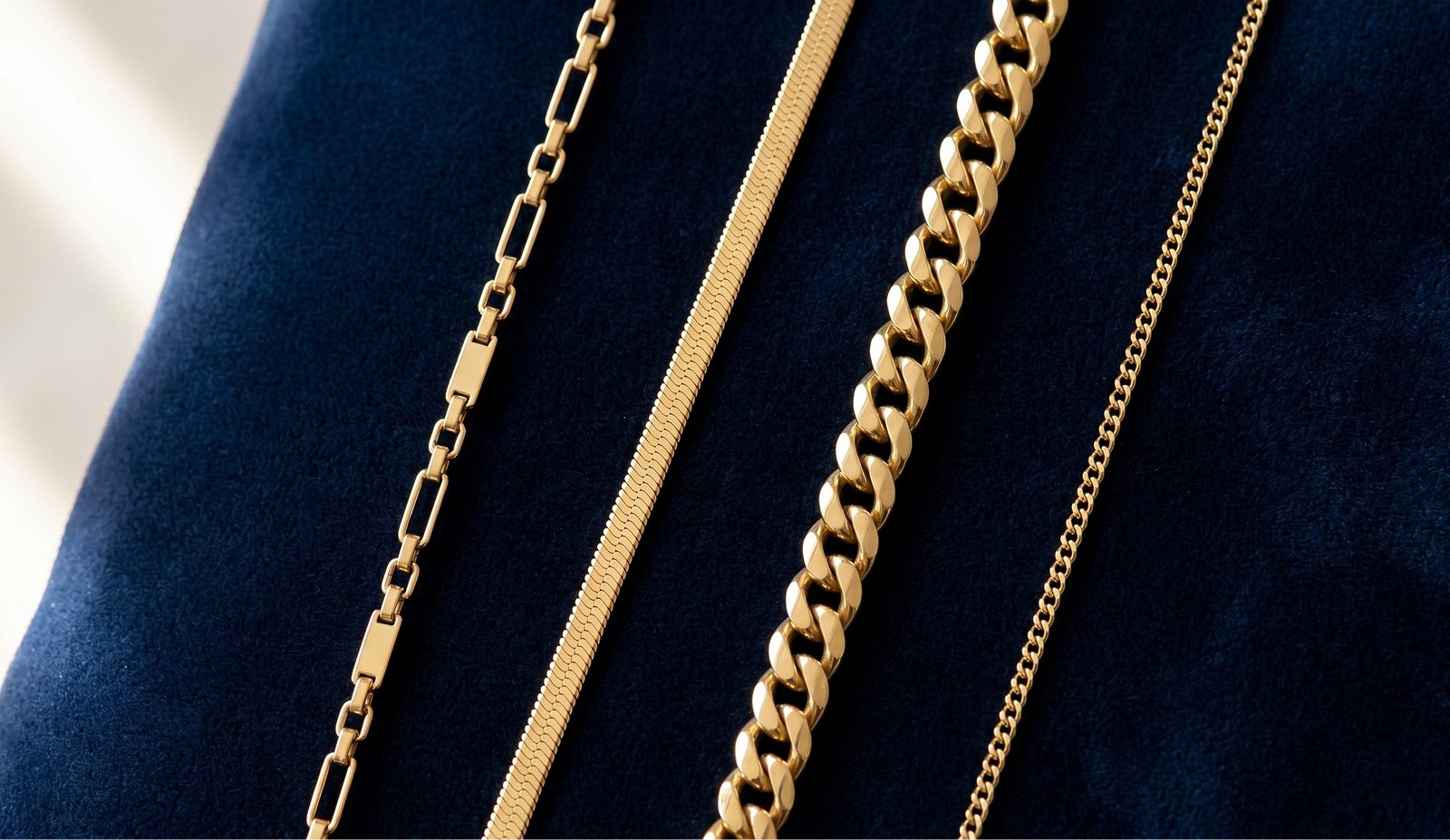
Types of Gold Chains
Cuban, rope, box, Figaro — and how to choose the right one.
Jewelry to Remember · 5 min read
If you’ve ever searched “gold chain” and felt like every option looks almost the same — until it suddenly doesn’t — you’re not alone. Chain style seems minor until you put it on.
Then you notice the drape, the shine, the weight, and how it sits with everything else you wear. Here’s a plain-language tour of the main solid-gold chain styles.
The Cuban Link Chain
The Cuban link chain is what most people picture when they hear “gold chain” — thick, flattened, tightly interlocking oval links that lie flat and dense against the skin. It is the most searched chain style for good reason: it is substantial without trying too hard, and it looks equally at home on men and women. Technically it belongs to the curb family — the links are twisted and flattened so they sit flush — but the Cuban runs heavier and more tightly packed than a standard curb, which is what gives it that solid, continuous-rope-of-metal look.
Because the links interlock so closely, a Cuban sits flat instead of rolling or twisting on the neck, and that is a big part of why it looks so good worn on its own. There is no pendant required — the chain is the statement. Width does most of the work here: a 3–4 mm Cuban reads as a refined everyday chain you can layer or wear under a collar, while 7 mm and up becomes a clear, confident centrepiece. For a first Cuban you will genuinely wear every day, 4–5 mm is the sweet spot most people land on and never take off. In solid gold, 10K’s extra hardness is a real advantage on a chain this dense — it shrugs off daily knocks — while 14K gives a slightly warmer, richer tone. You will find Cuban styles across several widths in our solid gold chains collection, in both 10K and 14K. Best for: wearing solo, a confident everyday chain, gifting for him or her.
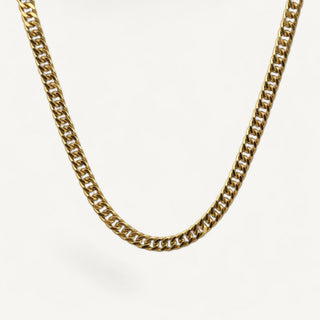
The Curb Chain
The curb chain is the Cuban’s quieter relative. It is built the same way — oval links twisted and flattened so they lie flat against each other — but the links are typically lighter and a touch more open, so the chain reads more understated than a true Cuban. If you like the Cuban silhouette but want something that sits a little softer and works as well under a shirt as over one, a curb is worth comparing side by side. It is one of the most versatile flat links: it layers cleanly with a thinner chain, takes a pendant without fighting it, and looks just as right on a 16-inch women’s length as a 22-inch men’s one. A curb in a moderate 3–5 mm width is a genuinely do-everything chain — present enough to notice, easy enough to forget you are wearing. Best for: everyday presence, layering with a finer chain, a pendant base.
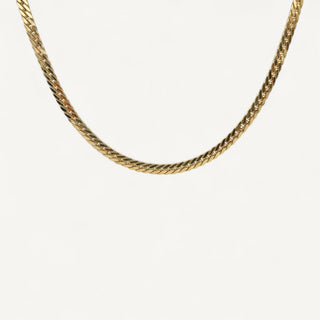
The Box Chain
The box chain is built from square links that fit together into a clean, continuous line — sometimes called a Venetian chain. Where a Cuban is dense and a rope is textured, the box is precise and architectural: smooth, sturdy and quietly modern. It is one of the best chains for a pendant because the square profile keeps the chain from twisting, so a drop hangs straight and centred every time. On its own, a fine box chain is an understated everyday piece that does not announce itself, which is exactly why minimalists reach for it. It also layers well with rounder links, adding a clean geometric line against a twisted rope or a flat curb. A box holds its shape better than most flat weaves, so it is forgiving of daily wear. Best for: pendants, minimal styling, clean layering, a chain that hangs straight.

The Herringbone Chain
Flat, slanted links lie in one direction to form a smooth, liquid ribbon of gold — that is the herringbone, and it is one of the most striking chains you can wear. It sits completely flat against the skin with a high, almost mirror-like shine, so even a narrow herringbone reads as a deliberate, dressed-up choice. The flat weave is its signature and also its one care consideration: a herringbone prefers to lie undisturbed, so it should be stored flat or loosely coiled rather than knotted or balled up, and clasped before it goes on. Treat it that way and it stays smooth and reflective for years. Because it delivers so much presence without bulk, the herringbone is ideal worn solo against bare skin or a simple neckline, where the unbroken sheet of gold can do its work. Best for: wearing on its own, dressier looks, high shine without heaviness.
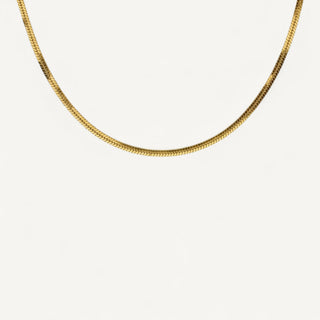
The Wheat Chain
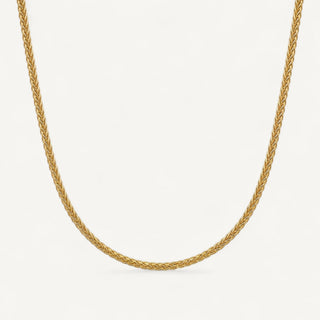
The wheat chain — often labelled Spiga — weaves multiple twisted strands into a dense, textured braid that resembles a stalk of wheat, which is where the name comes from. It is one of the more intricate constructions, and that tight weave makes it both durable and pleasing to look at up close, with a soft, woven shine rather than the sharp sparkle of a rope. From a distance it reads as a simple, substantial line; up close it rewards a second look. That combination — interesting detail, quiet overall impression — makes the wheat a great everyday chain for someone who wants texture without flash. It is sturdy enough to wear hard and holds a pendant securely thanks to its density. A wheat in a moderate width layers nicely under a bolder link, adding a subtle woven texture to the stack. Best for: everyday wear, subtle texture, layering, a chain that holds up to daily wear.
The Cable Chain
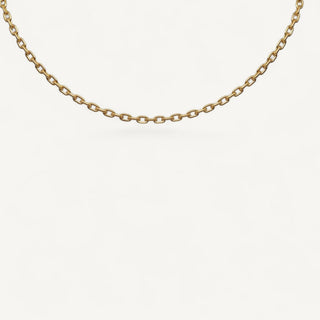
The cable chain is the foundation link — simple, familiar oval (or sometimes rounded-rectangular) links connected one to the next, the shape most people first picture as “a chain.” That simplicity is its strength: it is the most versatile and adaptable style, the natural first chain, and the easiest base for a pendant you plan to add later. Oval cable feels classic and smooth; a rectangular or “elongated” cable reads a little more modern and graphic, with more open space between links. Because there is no twist or pattern to compete with, a cable lets a pendant or a charm be the focus, and it layers naturally with almost anything. Fine cable chains are a layering staple; a slightly heavier cable stands on its own as an understated everyday piece. If you are buying a first solid gold chain and are not sure where to start, a cable is the safe, lasting choice. Best for: minimal daily wear, layering, a first chain, a pendant base.
The Rope Chain
A rope chain is made of small links twisted together in a spiralling pattern so the surface catches light from dozens of tiny angles at once — it throws the most sparkle of any classic style. That texture is the whole point: a rope reads a little dressier than a flat link and gets noticed across a room without being loud about it. The twisted construction is also surprisingly hard-wearing, which makes a rope a sensible everyday choice as well as a dressy one. It pairs beautifully with a pendant — the sparkle frames the drop — and it holds its shape well over time. Ropes look good across a wide range of widths: fine ropes layer delicately, while a 3–4 mm rope makes a satisfying standalone chain. In solid 10K or 14K gold the shine is real metal, not a coating, so it does not dull or flake the way plated ropes do. Best for: a dressier everyday chain, pendants, catching the light.
The Figaro Chain
A figaro chain repeats a distinctive pattern — typically two or three short round links followed by one longer flattened link — over and over down its length. That rhythm is what gives the figaro its character: it reads as detail and texture up close, and as a clean, recognisable line from a distance. It has been a long-standing favourite for men’s chains in particular, where the patterned links add interest without the bulk of a heavy Cuban, but it works just as well for women in finer widths. A figaro is a good pick if you want a chain that is clearly “a gold chain” but a little less expected than a plain link, and it wears a pendant nicely because the longer links give the bail a natural place to sit. Look at it in 3–5 mm for an everyday men’s chain, finer for layering. Best for: men’s everyday wear, a chain with built-in character, pendant chains. See the styles framed for him in our men’s jewellery collection.
Two chains can be the same metal, length and width — and still feel completely different on.
Choosing Width & Length
Width (listed in millimetres): 1–3 mm delicate and everyday; 4–6 mm the balanced everyday presence; 7 mm+ a clear statement.
Length: 16–18 in sits at the collarbone; 20–22 in at the chest (great for men and layering); 24 in+ sits lower and pairs with a wider link.
Common Questions
Use the FAQ section to answer your customers' most frequent questions.
Denser, rounded links like Cuban, box, and wheat take daily wear best. Flat weaves like herringbone prefer gentler handling. Across every style, choosing solid gold over a thin coating matters most.
For an everyday chain, most people are happiest at 4–6 mm — present enough to notice, comfortable enough to forget.
Absolutely — Cuban, rope, and Figaro are popular across the board. Width and length set the tone more than the style itself.
Jewelry to Remember
Shop the chains in this guide
 10K Yellow Gold Ethos Subtle Cuban Chain Necklace (18–24")$499.00
 10K Yellow Gold Veritas Substantial Curb Chain Necklace (18–26")$2,599.00
 10K Yellow Gold Verve Timeless Box Chain Necklace (18–24")$1,299.00
 10K Yellow Gold Arbor Graceful Wheat Chain Necklace (18–24")$699.00
Find Your Chain
Browse solid gold chains — each with its style, width, length, and weight listed. Shopping for him? See the men’s collection.
Read more
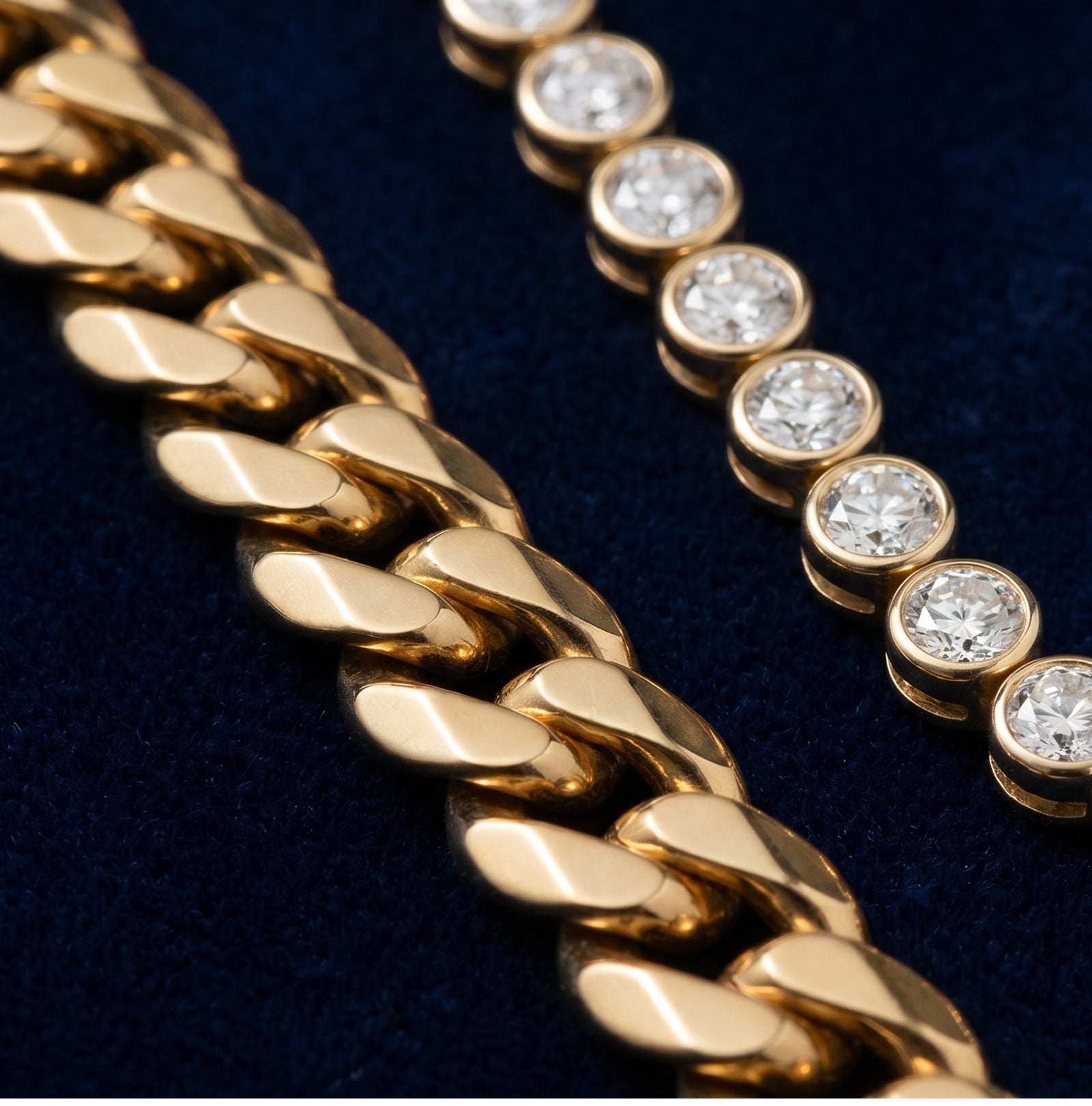
10K vs 14K solid gold — how karat changes durability, colour, and price, and which to choose for everyday vs special pieces. Real solid gold, made to keep.
A tennis bracelet is a single line of matched stones set in a flexible row of solid gold — simple, bright, and meant to be worn every day rather than saved for special occasions. It is one of the f...