



Gold chain width is the measurement that decides how a chain reads before anyone notices the link style, the length, or even the shine: whether it sits as a fine line of gold, a visible everyday band, or a piece that anchors everything around it. It is also the measurement online stores are structurally worst at communicating, because a product photograph can be taken at any magnification. The method this guide teaches takes ten seconds and works on any listing, anywhere: always ask the width in millimetres, in writing — then check that number at true scale against an object you already own. Below are the mm bands and what each reads as, a calibrated diagram you can hold a credit card against, and the arithmetic that connects width to gram weight.

What to look for: the three facts that settle width
Three facts settle nearly every width decision. First, the number itself: the width in millimetres, stated in writing on the product page. A serious listing publishes it the way it publishes the karat, because width is a physical specification, not an impression. Second, the band the number falls in. Widths cluster into three ranges — roughly fine (under 3 mm), middle (3 to 5 mm), and statement (above 5 mm) — and a chain behaves like its band far more than like its link style. Third, the weight the width implies. Width is the biggest single driver of how many grams of gold a chain contains, and grams are what you are actually paying for. The sections below take these in order, starting with the tool that makes the number mean something: a scale reference you can trust.
Check the number at true scale: how to use the width diagram
The diagram below is drawn to exact relative scale: thirteen of our chain widths, from 2.5 mm to 8.2 mm, rendered as bars whose thicknesses are true to one another and to the dashed calibration bar above them. That bar is the length of a standard credit card's long edge — 85.6 mm, a dimension standardized worldwide — which means almost everyone owns a perfectly accurate ruler without knowing it.

To use it: hold any bank or credit card up to your screen against the dashed bar, and adjust your browser zoom — or pinch-zoom on a phone — until the card's long edge exactly matches it. From that moment every bar on the diagram is life-size, and 5.6 mm stops being a number and becomes the actual thickness the chain will occupy at your collar. Two honest notes. The diagram begins at 2.5 mm, so our finest chain — the 1.7 mm Vero Petite oval cable chain — is about two-thirds the thickness of the thinnest bar shown. And the bars show width only, not the texture or movement of real links; that is what product photos are for, once the size question is settled first.
Why zoomed product photos make every chain look wide
A camera has no fixed magnification. A 2.5 mm chain photographed close enough to fill the frame produces the same commanding image as an 8 mm chain photographed from farther back — which is why nearly every chain online looks substantial, and why so many arrive looking finer than the buyer expected. This is not usually deception; macro photography is simply how you show the quality of a link. But it means a photograph can never answer the size question, and the disappointment reviews you see across the jewellery internet — "smaller than expected" — are almost all width surprises. Our own product pages carry the line "Images not to scale" for exactly this reason. The honest pair of tools is the one this guide is built on: the millimetre figure in writing, and a true-scale check against a real object before you buy.
The width bands, millimetre by millimetre
Chain widths sort into three bands, and the band predicts how a chain behaves on the body better than any product description can. The table gives the shape of it; the sections after it walk through each band with the real widths and gram weights of the chains we make. Widths here are the manufacturer's stated measurements for our solid 10K gold chains.
| Band | Widths | Reads as | Best jobs |
|---|---|---|---|
| Fine | 1.7–2.5 mm | A line of gold, close to the skin | Pendant carrier, first chain, the innermost layer |
| Middle | 3–5 mm | Visibly a chain, not yet the outfit | Daily solo wear, medium pendants, the anchor of a layered pair |
| Statement | 5.6–8.2 mm | The piece itself | Worn alone, no pendant needed |
1.7 mm to 2.5 mm: fine widths, read as a line
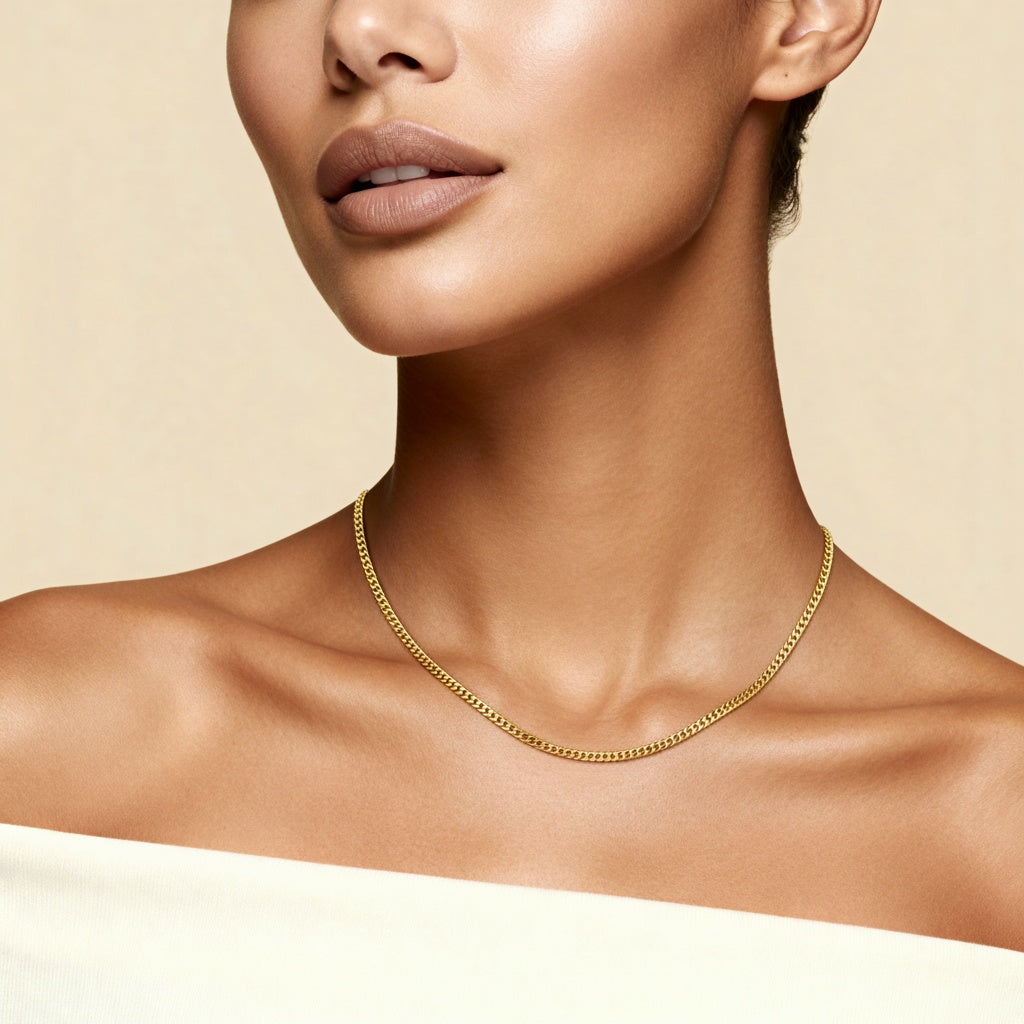
At this width the eye registers a bright line rather than individual links. On women this is the classic pendant and layering territory; on men, a 2.5 mm chain reads deliberately minimal — present when noticed, invisible when not. The practical strengths are comfort and versatility: our 1.7 mm Vero Petite weighs roughly 1.6 g at 20 inches and disappears under any collar, while the 2.5 mm Ethos Subtle Cuban, at about 4 g, is the finest width that still shows its link pattern at conversation distance. The trade-off is delicacy: fine chains carry small pendants well but should not be asked to carry heavy ones, and they are the width band where clasp quality and careful handling matter most.
3 mm to 5 mm: the middle band, visibly gold
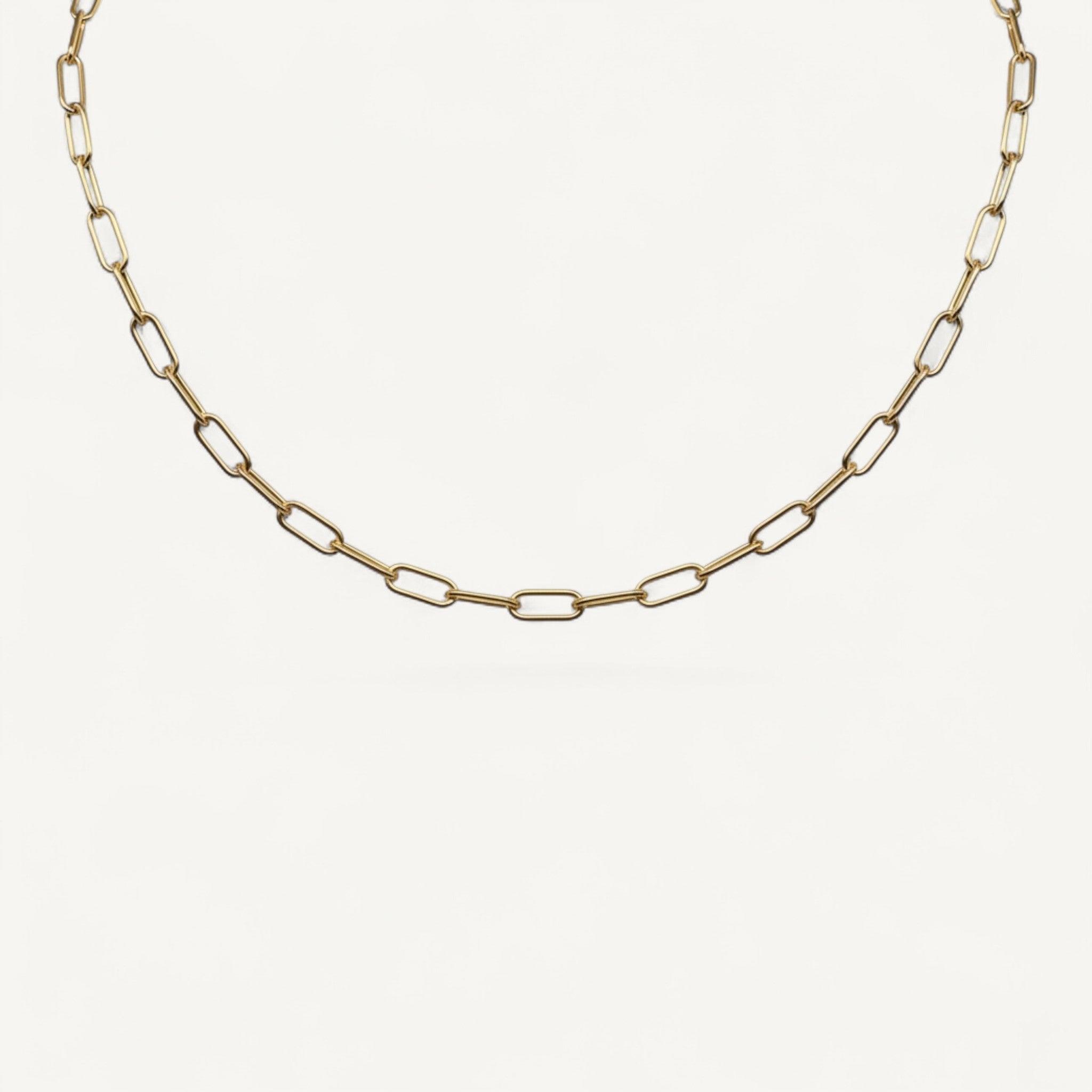
This is the band most people actually want when they say they want "a gold chain": wide enough that the links read as links across a table, not so wide that the chain wears the person. It suits daily wear on any frame and either gender — a 3.2 mm Cuban sits quietly under a shirt, a 4.5 mm paperclip holds its own over a sweater — and it is the natural anchor for a layered pair, worn under a finer chain. One thing worth knowing: width reads relative to the body wearing it. The same 4.6 mm chain looks bolder on a narrow frame and quieter on a broad one, which is precisely the judgment the true-scale diagram above lets you make before buying rather than after.
5.6 mm to 8.2 mm: statement widths, the chain as the piece
Above 5.5 mm the chain stops accompanying an outfit and starts being the point of it. Our statement range runs from the 5.6 mm Horizon Striking curb to the 8.2 mm Veritas Majestic curb, and the defining fact of the band is how steeply substance climbs with width: about 13.3 g at 20 inches for the 5.6 mm, 23.3 g for the 6.8 mm, 33.2 g for the 8.2 mm. These are unisex widths in principle — the fashion world has long since put wide curbs on everyone — but they are commitments in weight and presence, which makes the true-scale check above less a convenience than a requirement. No pendant is needed at this width, and most look better without one.
Matching width to a pendant
A pendant changes the width question, because the chain is now a frame rather than the picture. The working rule is proportion: the chain should be visibly finer than the pendant it carries, so a small charm or solitaire sits naturally on a 1.7 to 2.5 mm chain, while a heavier medallion needs the 3 to 5 mm band for both looks and strength. Check one mechanical detail before anything else — the pendant's bail, the loop it hangs by, must actually pass over your chain's width and clasp. And the reverse rule holds too: statement widths are almost never improved by a pendant, because two focal points compete. If your plan is pendant-first, choose from the finer end of our necklaces and let the pendant do the talking.
Layering widths: contrast beats matching
Two chains of the same width worn together read as a mistake — they tangle visually even when they do not tangle physically. Layering works on contrast: pair widths from different bands, roughly one band apart, so each chain keeps its own job. A 1.7 mm cable over a 3.2 mm Cuban reads as a fine line accenting a solid one; a 2.5 mm Cuban over a 4.6 mm curb does the same at higher volume. Separate the lengths by about two inches so the widths stack in order, finest and shortest at the top. This logic is the same for everyone; the widths you start from are the only variable. It is also the honest argument for buying the fine chain first — it will still earn its place the day a wider one arrives.
How width becomes weight — and weight becomes price
Width drives price through one mechanism: metal. A chain's gram weight grows with its cross-section, not its length alone, so width increases compound quickly — our 2.5 mm Ethos Subtle Cuban weighs about 4 g at 20 inches, the 4.6 mm Ethos Essence about 11.7 g, and the 8.2 mm Veritas Majestic about 33.2 g. Tripling the width did not triple the gold; it multiplied it by more than eight. Since solid gold is priced by its metal, price follows the grams, and the gold market moves daily — which is why this page prints no dollar figures. The current price of any width is on its product page, and the full range is in our solid gold chains collection.
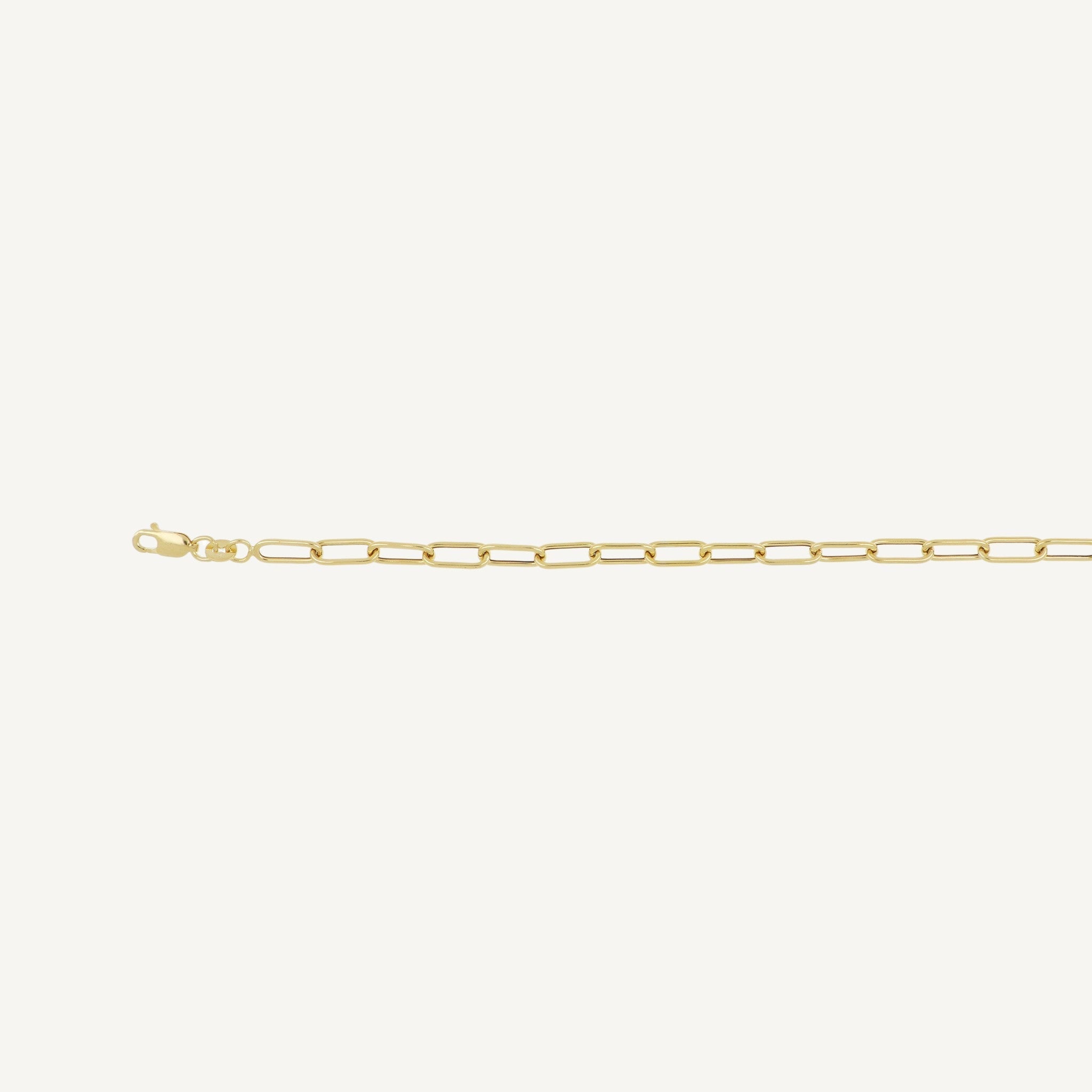
One refinement keeps the mechanism honest: construction matters as much as width. A dense link packs far more metal into the same millimetres than an open one — our 4.5 mm Verve Substantial box chain carries about 17.4 g at 20 inches, while the 4.5 mm Parallel Balanced paperclip, identical in width, carries about 6.8 g, because its long open links are mostly air. Same width, wildly different object. This is why the honest measure of a chain is always the pair of numbers together — millimetres for how it looks, grams for what it is — and why a listing that states both is telling you everything the photographs cannot; ours state both on every page. For what the link shapes themselves mean, see our guide to the different types of gold chains.
Shop the range: one fine, one middle, one statement
Three chains from our catalogue, one from each band, chosen to make the widths concrete. Every one is solid 10K yellow gold, made in Italy, with the width and the gram weight for every length published on its page — current prices live there too.
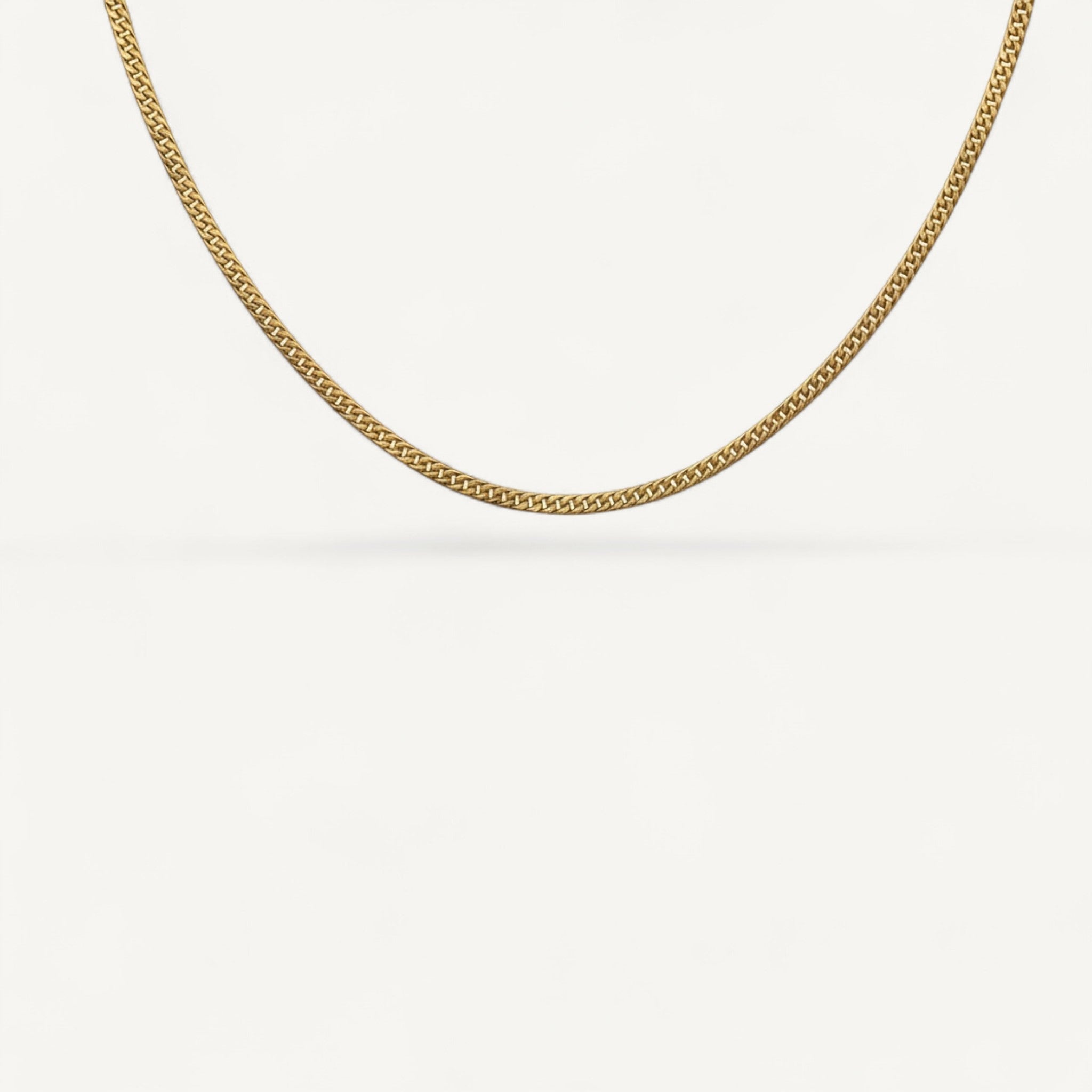
Shop the pieces in this guide: 10K Yellow Gold Ethos Subtle Cuban Chain Necklace · 10K Yellow Gold Parallel Balanced Paperclip Chain Necklace · 10K Yellow Gold Veritas Substantial Curb Chain Necklace.
How to choose: pick the job first, then the millimetre
Width is easiest chosen backwards — decide the chain's job, and the band follows. If the chain will carry a pendant or live under other chains, choose fine: 1.7 to 2.5 mm. If it will be worn on its own most days, choose the middle band, 3 to 5 mm, and use the true-scale diagram to pick the exact number your frame and taste want. If the chain is meant to be the piece, go 5.6 mm and up — but confirm the width against a card first and look at the gram weight second, because at this end the weight is the commitment. Men choosing between these bands are making the same decision with the same numbers; for the specifically men's questions of neckline, length and link style, our guide to men's gold chains — width, length and style owns that ground, and the men's jewellery collection is sorted for it.
And wherever you buy: the width belongs in writing. A listing that states its millimetres — and its grams — is inviting you to check; a listing that offers only photographs is asking you to guess. Ask the mm. Then check it at true scale. Those ten seconds are the whole method.
Common questions about gold chain width
What is a good gold chain width for everyday wear?
For a single chain worn daily, the middle band — 3 to 5 mm — is the dependable answer: visible enough to read as jewellery, light enough to forget. If you want something quieter or plan to add a pendant, a 2 to 2.5 mm fine chain does everyday duty just as well, closer to the skin.
Does a wider chain always cost more?
No — width without weight says little. Think in grams, not dollars: width sets the gram weight, gram weight sets the price, and the gold market moves the price daily — so set your budget first, then buy the most metal it honestly covers. A fine 1.7 mm chain contains a few grams of solid gold; an 8.2 mm chain contains more than thirty. Current prices for every width are in our chains collection.
What chain width do I need for a pendant?
Finer than the pendant, as a rule — small charms and solitaires sit best on 1.7 to 2.5 mm chains, heavier medallions on 3 to 5 mm. Confirm the pendant's bail passes over the chain's width and clasp before buying either piece.
Is a 2.5 mm chain too thin for a man?
No — 2.5 mm is a deliberate minimal width on men, worn close to the skin or as the finer half of a layered pair. Whether it is right for you is exactly what the true-scale diagram answers: match a card to the bar and look at the 2.5 mm line at life size.
How do I know a chain's real width before buying?
Never from the photos — magnification makes every chain look wide. Find the width in millimetres stated in writing on the listing, then check that number at true scale against a real object, the way the calibrated diagram in this guide works. If a listing will not state the millimetres, skip it.
Magasinez ce guide
En lire plus
If you are wondering how to buy gold jewellery without getting burned, the good news is that you do not need a jeweller's training. You need six checks, and every one of them can be run from the li...
What is a tennis bracelet? The short answer: a single, continuous line of matching stones — usually round diamonds — each held in its own small setting, joined by hinged links so the whole row bend...