



Gold Stud Earrings: How to Choose Size, Karat and Setting
Diamond stud earrings are one of the most practical pieces of jewellery you can own. They work with almost every outfit, they do not compete with a neckline, and a well-chosen pair lasts decades. But gold stud earrings come in enough variations — carat weight, gold colour, setting style — that the choice is less obvious than it looks. This guide walks through each decision in plain terms so you land on the right pair the first time.
The stud buying decision in 60 seconds
Three things determine whether a stud earring is right for you:
- Carat weight — controls the physical size of the stone. A 0.25 ct stone sits at roughly 3.2 mm across. A 1.5 ct stone sits at roughly 7.5 mm. This is the biggest factor in how the earring reads from a normal conversation distance.
- Gold colour — yellow gold or white gold changes who the earring flatters and how formal it reads. Both are 14K solid gold at Jewelry to Remember; the difference is purely aesthetic.
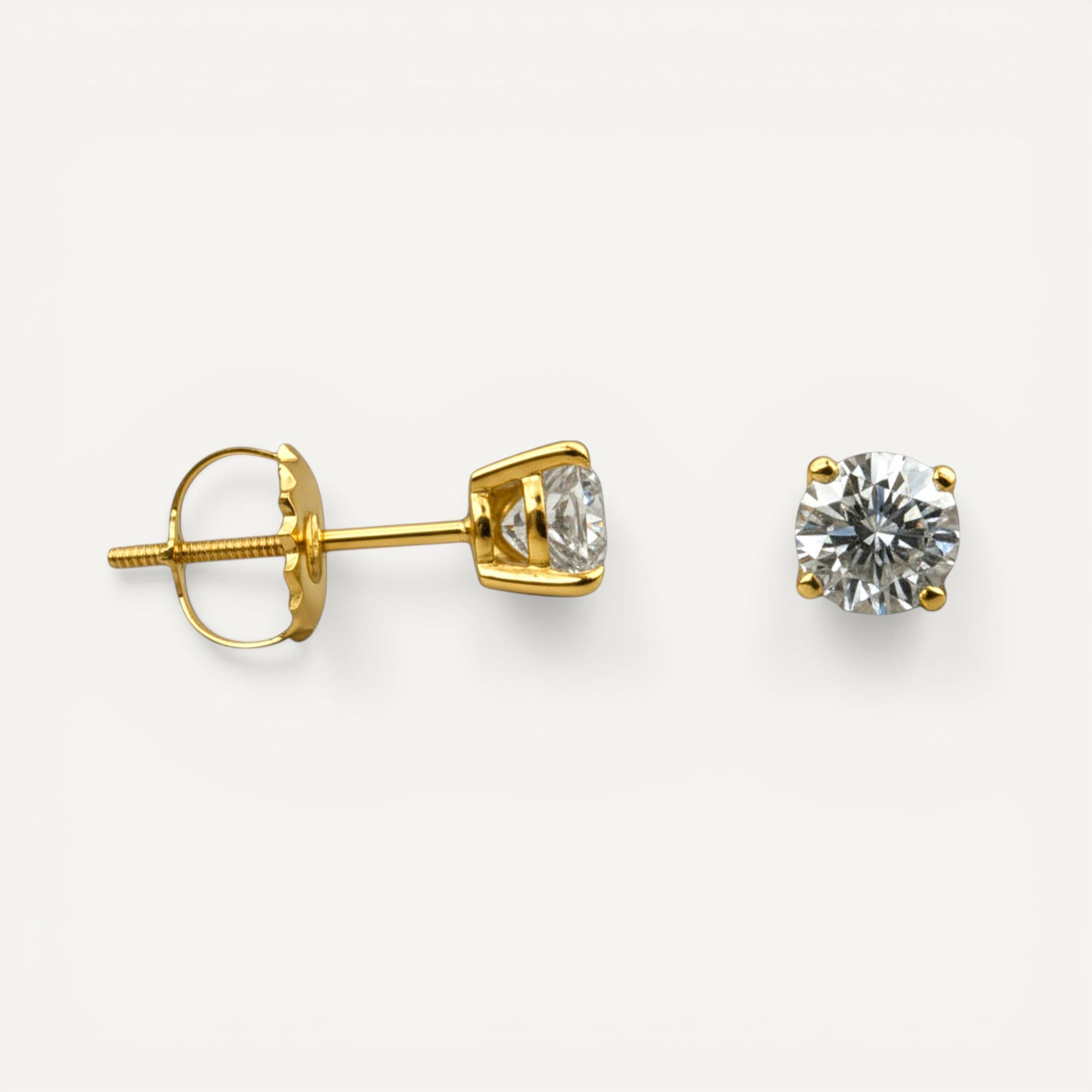
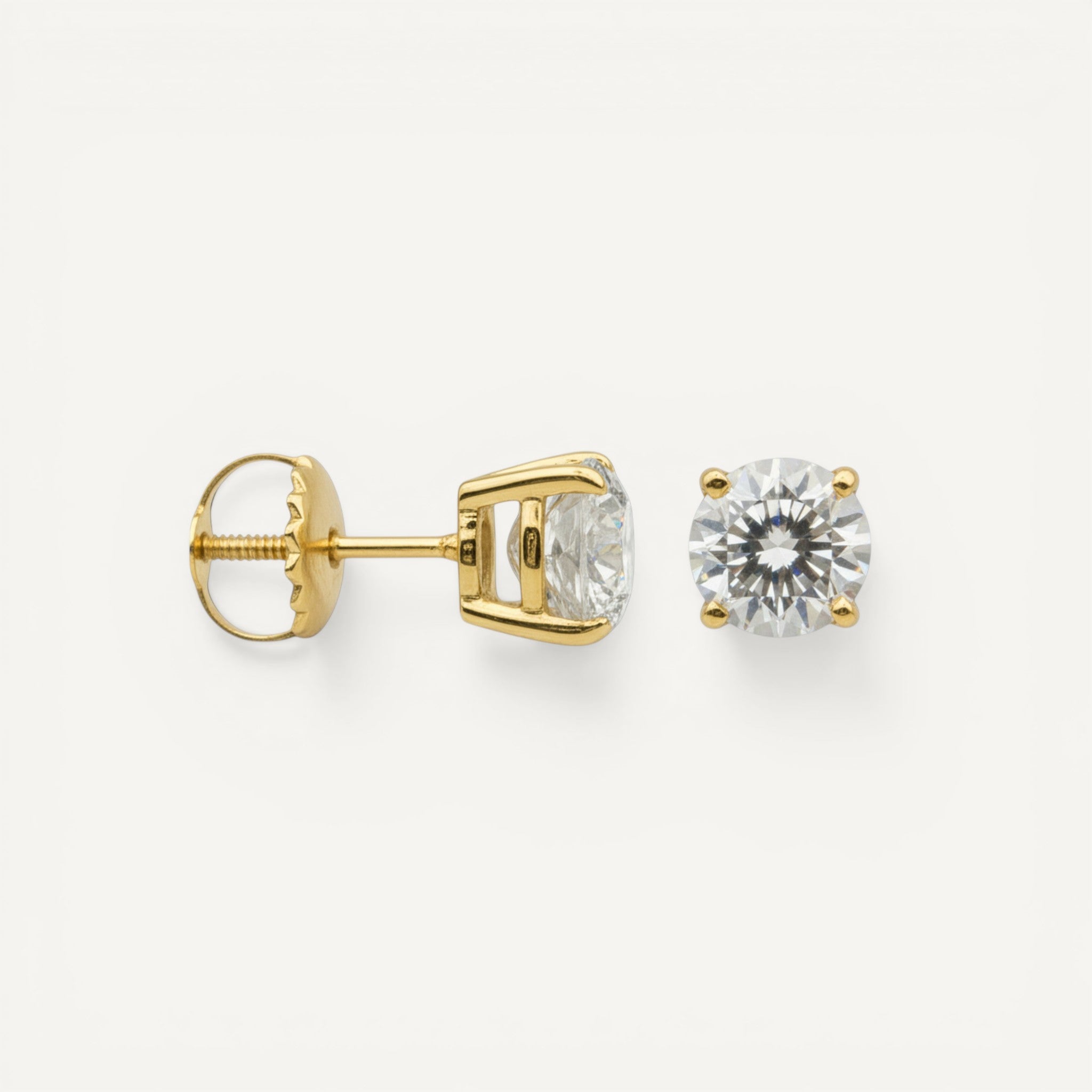
- Setting type — the prong is the workhorse (maximum light return, secure grip); the bezel wraps the stone in a metal rim (more modern, lower profile). For everyday wear, both hold a diamond securely in 14K gold.
If you already know your preferred size and colour, jump to the shop section below. If you want to understand each factor before deciding, read on.
Size guide: carat weight to mm to visual presence
The number on a diamond listing is carat weight, not millimetres. Those two numbers are related but not the same — and the millimetre measurement is what tells you how the earring actually looks on the ear.
Here is the practical size ladder for round brilliant diamonds:
- 0.25 ct — approximately 3.2 mm: A small, discreet stone. From a metre away it reads as a clean point of light rather than a defined shape. This is the earring you forget you are wearing. Good for office, everyday, and sleeping in (if your piercing is well-healed).
- 0.50 ct — approximately 5.0 mm: The most versatile size. Visible and polished without being conspicuous. Most people who say they want a "classic" stud mean this size.
- 1.0 ct — approximately 6.5 mm: Now the diamond is clearly present. Reads well across a table, photographs easily, works for both workday and evening without switching earrings.
- 1.5 ct — approximately 7.5 mm: A statement size. You notice it. It suits larger lobes or someone who prefers a bolder look; it also suits occasions where the earring is meant to be part of the look rather than quietly supporting it.
For exact mm measurements and a visual comparison at scale, see our stud earring size chart — it maps carat to mm to a life-size ring diagram so you can hold the page against your earlobe before you order.
One practical note: the size that reads right also depends on lobe size. A large lobe makes a 0.25 ct stone look smaller than the spec implies; a small lobe makes a 1.0 ct stone look larger. The size chart accounts for this with proportion notes.
Yellow gold vs white gold studs: which setting to choose
Both our yellow and white gold studs are solid 14K gold — the difference is the alloy blend, not the quality. Yellow gold is 14K with copper and zinc in the mix; white gold is 14K with palladium or nickel and typically finished with a rhodium plate that wears down over years (this is normal and the piece can be re-rhodiumed by any jeweller).
The practical colour decision:
- Yellow gold flatters warm and olive skin tones. It reads warmer and a little softer than white gold. Against dark hair or skin it has particular impact. Yellow also reads as more classically fine-jewellery.
- White gold reads as more neutral and contemporary. It does not compete with the diamond's colourless appearance the way a yellow setting can. Against fair or cool skin tones it tends to disappear in a clean way. It also pairs more easily with silver-toned accessories.
If you are unsure, yellow gold is the more versatile choice across a wider range of skin tones and outfits. If you already wear mostly silver or white-metal jewellery, white gold will integrate more naturally into your existing pieces.
Why 14K is the right karat for stud settings
Stud earrings use either a prong setting or a bezel setting, and both require the setter to push or burnish metal around the stone to hold it in place. This process works better on 14K gold than on 10K gold.
The reason is hardness relative to workability. 10K gold (41.7% gold content) is harder and more brittle under the jeweller's tool. When a setter works the prong tips down around the girdle of the diamond, 10K prongs are more likely to crack or snap under pressure. 14K gold (58.5% gold content) is slightly softer at the prong tip — which means the metal moves correctly around the stone without fatiguing.
This is not a knock on 10K gold: for chains and hoops it is an excellent choice because daily wear hardness matters more than setting workability. But for a prong-set diamond stud, 14K is the right call. Our entire stud collection is 14K for exactly this reason.
If you want to go deeper on the 10K vs 14K decision for the rest of your jewellery, the 10K vs 14K solid gold guide covers it fully.
Setting types: prong vs bezel
The setting is the metal framework that holds the stone. For round diamond studs, two settings dominate:
Prong setting: Four or six thin metal claws grip the diamond at the girdle, leaving the sides and bottom of the stone exposed. This maximises light entry and gives the stone the brightest appearance. Prongs also elevate the stone slightly above the earlobe, which adds to the impression of size. The trade-off is that prong tips can catch on hair or fabric over years of wear, and need inspection periodically.
Bezel setting: A continuous metal rim wraps around the entire circumference of the stone, sitting flush with or just above the girdle. The stone is more protected — there are no prong tips to snag — but slightly less light reaches the pavilion. Bezel-set studs have a cleaner, lower-profile look. They tend to suit people who prefer a more contemporary or minimal aesthetic.
For everyday wear, both settings hold a diamond securely. If you are active with your hands or tend to wear earrings during sport, a bezel is worth considering for its protected perimeter.
Lab-grown diamonds in stud earrings: what to know
Our stud collection uses lab-grown diamonds. Lab-grown diamonds are physically and chemically identical to mined diamonds — same carbon crystal structure, same hardness (10 on the Mohs scale), same optical properties. The difference is origin and price.
Because lab-grown stones cost significantly less to produce than mined equivalents, we can offer a larger stone in a solid 14K gold setting at a price that would be out of reach with a mined equivalent. A 1.0 ct lab-grown diamond stud in 14K yellow gold costs $499 at Jewelry to Remember — a mined equivalent in the same metal would be substantially more.
If you want a full breakdown of how lab-grown and natural diamonds compare across price, durability, and resale, the lab-grown vs natural diamonds guide covers every factor honestly without a sales angle on either side.
How to wear studs with hoops: layering your ear
A round diamond stud pairs well with a small hoop in a second piercing — the shapes complement each other. The general rule: the stud should be the focal point, so the hoop should be smaller in visual weight. A 14–16 mm yellow gold hoop in a second lobe hole balances a 0.50 ct or 1.0 ct stud in the first hole without competing with it.
White gold studs with yellow gold hoops is a mixed-metal combination that reads intentional rather than mismatched, particularly for a lobe stack. Yellow gold studs with yellow gold hoops keeps the look unified.
For more on sizing and choosing hoops to pair with, see the gold hoop earring size guide.
Care: keeping your stud earrings clean
Solid 14K gold does not tarnish through to the core. What builds up on stud earrings is a film of skin oils, lotion, and hair product that accumulates behind the stone and dulls the stone's appearance. The fix is warm water, a drop of dish soap, and a soft-bristle toothbrush — a gentle scrub around the prongs and the back plate, then a rinse and a pat dry with a lint-free cloth.
Avoid ultrasonic cleaners for prong-set stones unless a jeweller has confirmed the setting is tight. Avoid bleach-based cleaners. Remove studs before applying aerosol hairspray, as the propellant coats the stone and dulls it faster.
Clean once a month if worn daily; the difference in brilliance after cleaning is immediately visible.
Shop gold stud earrings
All Jewelry to Remember studs are solid 14K gold — yellow or white — with lab-grown diamond stones. Every pair ships from Canada with free returns on sizing questions. Below is the full size ladder, from petite everyday to statement occasion.
Shop this guide

Read more
Lab-Grown vs Natural Diamonds: An Honest Guide for Jewellery Buyers The question of lab grown vs natural diamonds comes up in nearly every diamond jewellery purchase now — and the honest answer ...
How to Layer Gold Necklaces: A Practical Guide Knowing how to layer necklaces sounds like it should be simple. Pick two chains, put them on. But if you've ever ended up with a tangled knot at th...