



If you have followed gold jewellery prices in Canada for any length of time, you have watched numbers do something jewellery is not supposed to do: change. The same solid gold chain can cost more than it did in the spring, or — less often noticed — cost less. Neither move is a mystery, and neither is a marketing decision. A solid gold piece is mostly metal, the metal has a public market price that moves every trading day, and an honest price has to follow it. This article explains the machinery in plain language: what a solid gold price is made of, why the gold market moves, what the Canadian dollar adds on top, and how that is reflected in our own prices — which is why several of our chains cost less in late July 2026 than they did in early June.

What a solid gold price is made of
Strip any solid gold piece down to its receipt and you find two parts. The first is the metal: the piece's weight in grams, multiplied by its purity, multiplied by the market price of gold on the day. The second is the work: forming the links, finishing the surface, the clasp, quality control, and the ordinary costs of running a shop. The work part is comparatively stable — a clasp does not cost more this month than last. The metal part is the live wire. It is the portion of the price that is connected, through a purity percentage and a scale, to a world market.
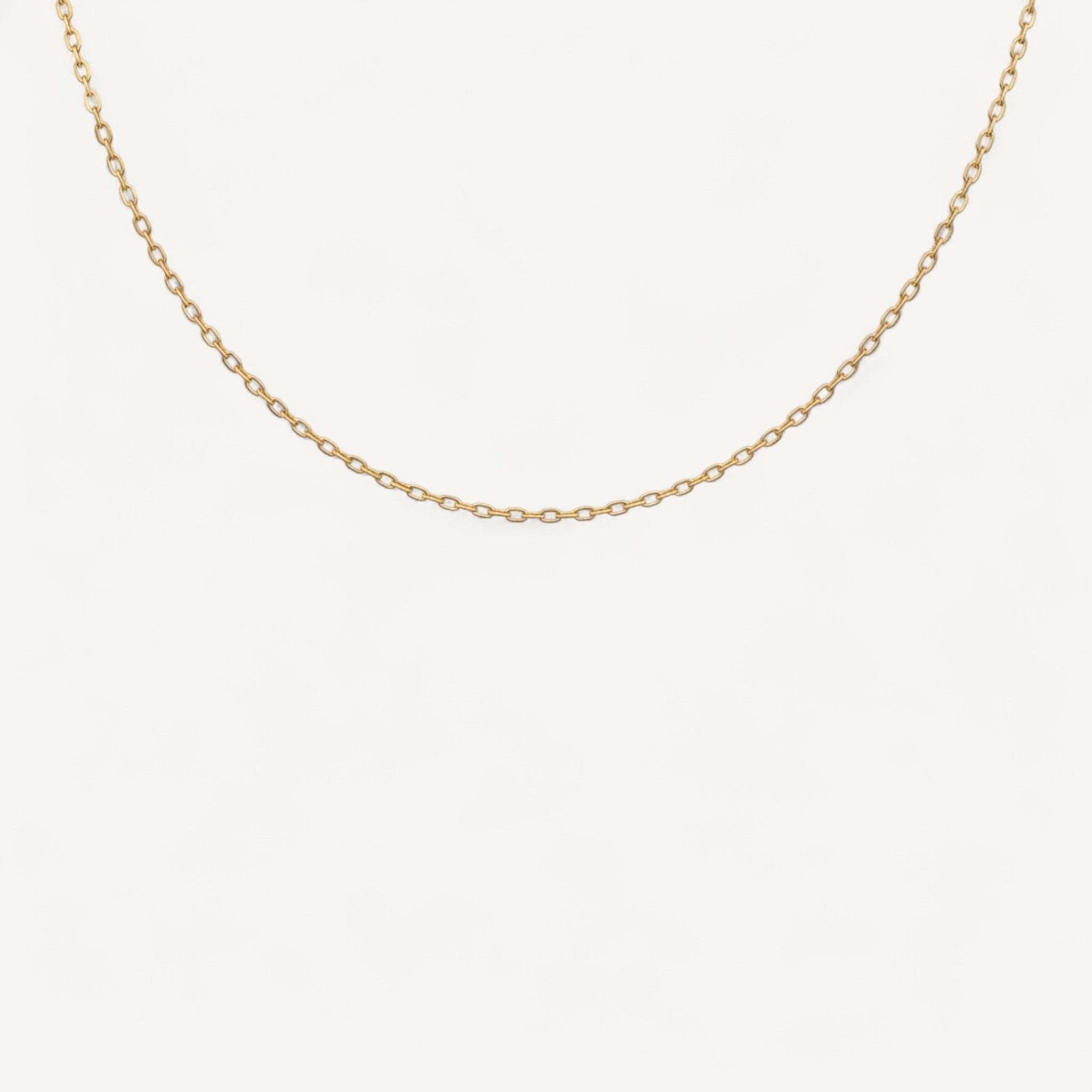
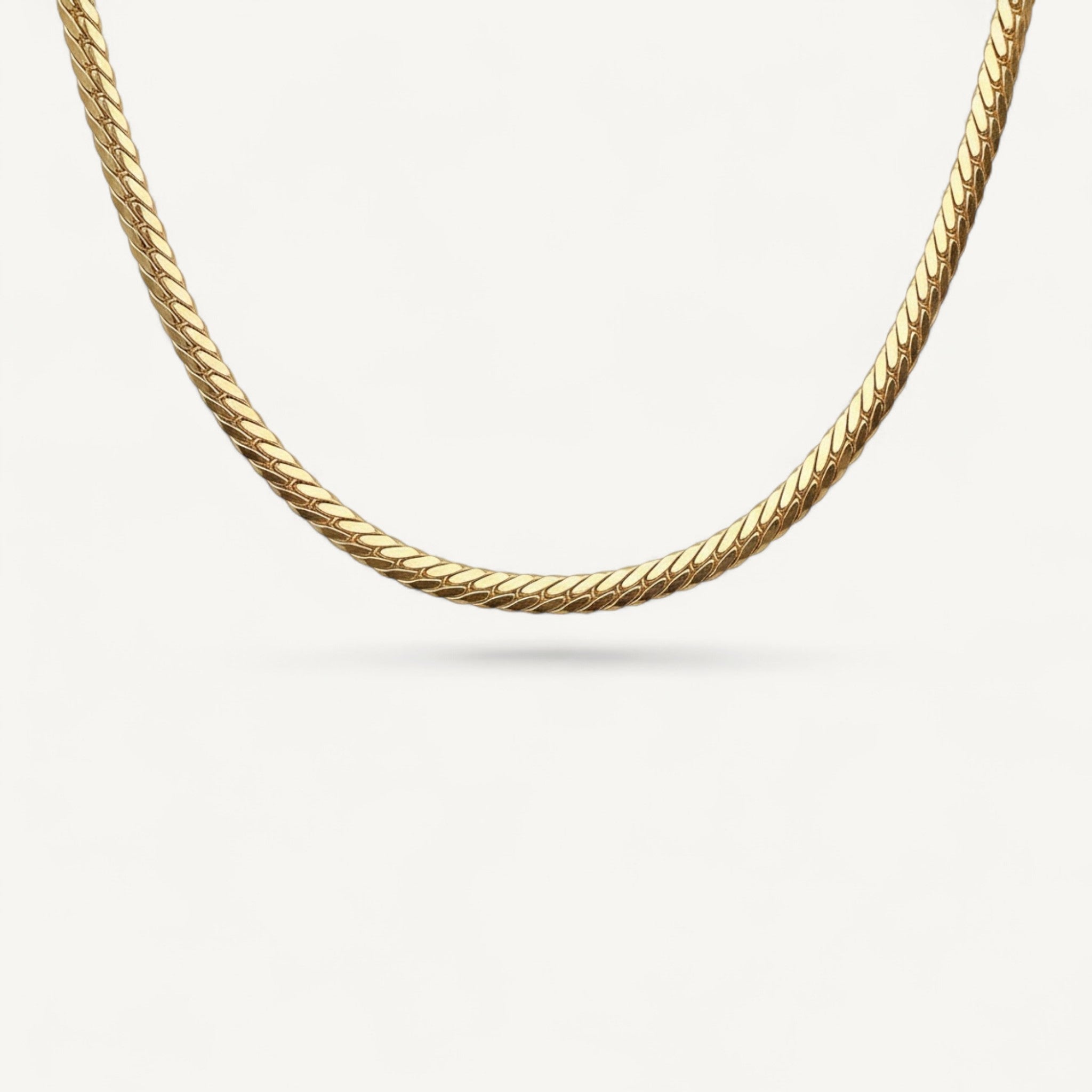
How much of the price the metal represents depends on how much metal there is. A fine 1.7 mm cable chain carries under two grams of gold, so the work is a meaningful share of what you pay. A 4.6 mm Veritas Enduring curb chain carries around 13.6 g at 20 inches — at that weight, the object is overwhelmingly metal by value. This is why we publish the approximate gram weight for every length on every chain's page: the weight is the bridge between the price you see and the market anyone can look up.
For what chains actually cost by width and weight, see our guide to gold chain prices in Canada.
Why the gold market itself moves
Gold has one of the most public prices of anything you can buy. It trades continuously on world markets, and two benchmarks are quoted everywhere: a reference price set in London twice each business day, and the futures price on the New York exchange. You can look either up in seconds, for free, and they move — daily, sometimes sharply, in both directions. No jeweller sets this number, and no jeweller escapes it.
What moves it is the ordinary push and pull of a global commodity. Central banks add to or slow their reserve buying. Jewellery demand rises into wedding and festival seasons in the countries that buy the most of it. Electronics manufacturing takes its steady share. Mine supply changes slowly, so it rarely rescues a tight market. And when the wider financial world gets nervous, more buyers want gold at once, which pushes the price up until the nervousness passes. The honest summary is that nobody reliably predicts the next move — not banks, not analysts, and not us. What can be said with confidence is only that the price will keep moving, and that both directions remain available.
Gold jewellery prices in Canada: the currency layer
There is a second moving part that headlines usually skip. Gold trades globally in US dollars, but gold jewellery prices in Canada are set in Canadian dollars — so a CAD price contains two markets at once: the gold price itself, and the CAD/USD exchange rate. When the two move in opposite directions they can partly cancel each other; when they move together they compound. This is why the change you see on a Canadian price tag does not always match the change you read about in a US headline, and why a Canadian buyer checking the arithmetic should use the gold price quoted in Canadian dollars, which the same public sources publish.
The currency layer also carries a practical buying point. A piece priced in CAD from a Canadian seller has the exchange rate already inside the number, settled at the moment you pay. A price in US dollars from a seller abroad leaves the conversion — plus any duties and brokerage at the border — to be discovered after the decision is made. Neither structure changes what the gold is worth; one of them just tells you the whole truth at checkout. Everything in our solid gold chains collection is priced in CAD and ships domestically, so the number on the page is the number.
Our practice: prices that move in both directions
Our prices are not set by feel and left alone. Each chain's gram weight and purity are fixed physical facts, and we review our prices against the gold market as a matter of course — which is why they have gone up in some seasons and come down in others. There is no sale banner in either direction, because neither move is a promotion — it is the same formula run on a different day.
The metal is the dominant ingredient, the metal's price is public, and a price that tracks its main ingredient is the only kind a customer can verify. It also means we give up something: the price you saw last month may not be the price today, in either direction. What you can count on checking is that the price you pay reflects the metal as of our most recent review, and that the gram weight on the page lets you check the relationship yourself.
What happened this summer, on the record
Between early June and late July 2026, the gold market eased, and our prices followed it down: across roughly eight weeks, several of our chains were repriced five to eight per cent lower. The 20-inch weights and widths on those pages did not change by a milligram — the same physical objects, the same Italian links, the same clasps — only the market input changed, and the arithmetic passed the change on. We keep dated records of our own catalogue.
We mention it not because down is better than up, but because down is the direction that proves the system. Any retailer will raise prices when metal rises; passing a decline through to the customer is rarer, because it costs something — and it is the part that makes the rest of the claim believable. The market has also moved the other way since we opened, and it will again — we make no prediction about which direction comes next, and you should be suspicious of anyone who does.
The price that never moves
Once you see the mechanism, a still price becomes informative. Gold moved substantially over the past few years — in both directions within single seasons. A solid gold price that sat perfectly still through all of it usually means the metal is a small enough share of that price that the seller can absorb the swings. That is not fraud; it is a cushion, and the cushion is built from the gap between the price and the metal. The wider the gap, the calmer the tag.
There is also an innocent version. A chain that is not solid — vermeil, or plated — contains very little gold by weight, so its price has no real reason to follow the metal: a coated chain's cost is mostly base metal and work, and a stable price on one is just accurate. Our explainer on how solid gold compares with every coated construction covers how each is built. The useful habit for a buyer is to hold the two facts together: the more gold a piece truly contains, the more its honest price should breathe with the market.
Where the current numbers live
The four chains below are ordered by gram weight — the heavier the chain, the larger the share of its price that is metal. Prices are not printed here; the current price, the width, and the weight at every length live on each product page.
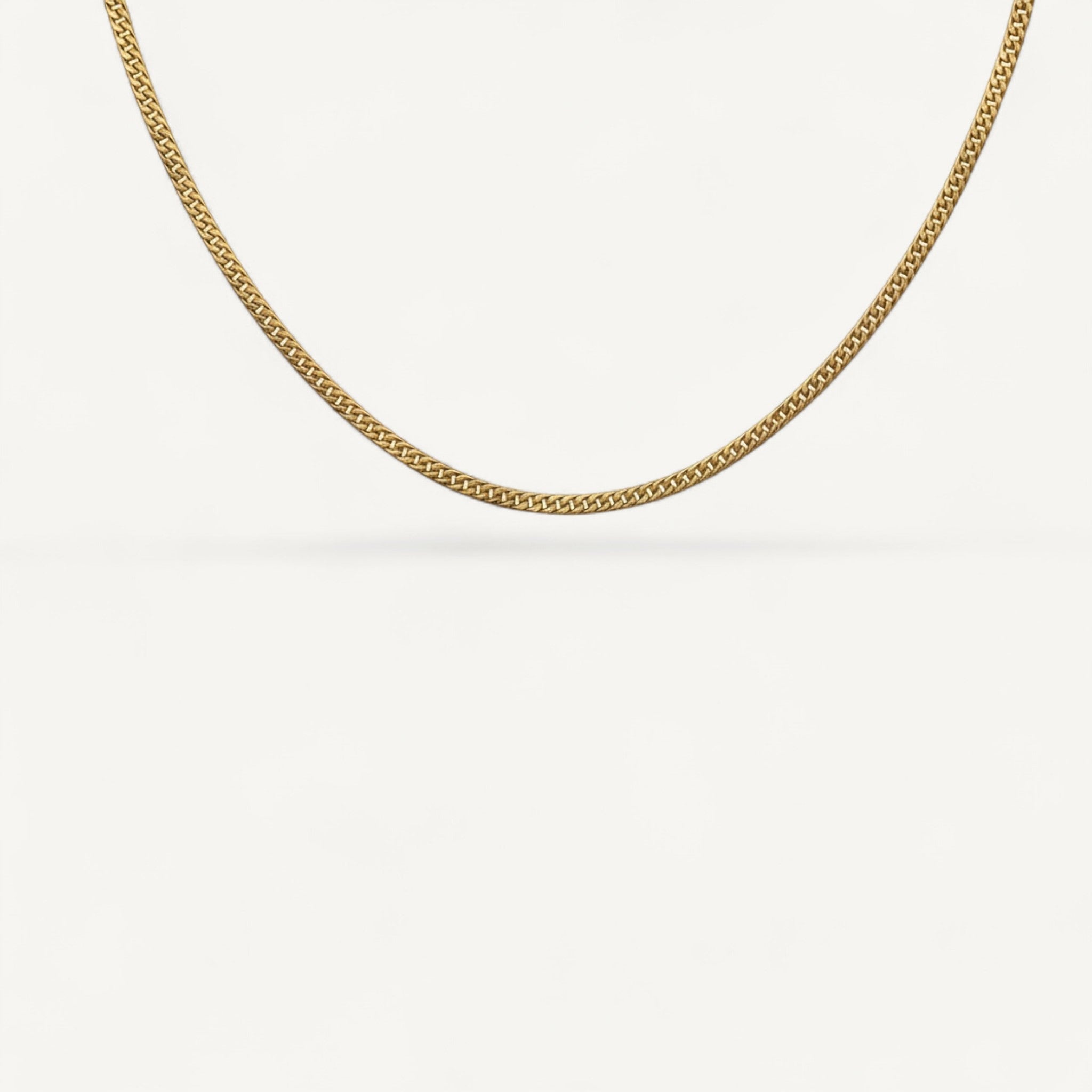
Shop the pieces in this guide: 10K Yellow Gold Vero Petite Oval Cable Chain Necklace · 10K Yellow Gold Ethos Subtle Cuban Chain Necklace · 10K Yellow Gold Veritas Enduring Curb Chain Necklace · 10K Yellow Gold Verve Substantial Box Chain Necklace.
How to choose: buy the piece, not the chart
Knowing why prices move is useful for exactly one decision, and it is not when to buy. We will not tell you to wait for a dip or to hurry before a rise, because both pieces of advice require knowing the market's next move, and nobody honestly does. The chart is not your problem. Your problem is the ordinary, pleasant one: which chain, at which width and weight, for which neck and which decades of wear. Those are questions with good answers on any market day.
So choose on the physical facts, because they are the part that never gets repriced. Decide the width that suits the wearer, check the gram weight at your length, and pick the karat whose colour and hardness you prefer — 585-stamped pieces sit in our 14K gold collection if the warmer tone is the draw. Whatever day you buy, the price will be the metal plus the work, calculated from the market as we review it, not guessed at last year. That is the whole idea, and it runs in both directions. And the 30-day window means every physical fact on the page can be verified on any market day.
Common questions about gold jewellery prices
Why do gold jewellery prices change in Canada?
Because a solid gold piece is priced from its metal, and the metal has a public market price that moves every trading day. Canadian tags add a second moving part: gold trades in US dollars, so a CAD price also reflects the CAD/USD exchange rate. An honest solid gold price follows those inputs over time.
Do gold jewellery prices ever go down?
Yes. When the metal market falls enough to matter, a price built from the metal falls with it. Between early June and late July 2026, several of our chains were repriced five to eight per cent lower for exactly that reason — same pieces, same gram weights, lower market input. The market has also moved the other way since we opened; nobody reliably times it, which is why we suggest choosing by width, weight and wear instead.
Should I wait for gold prices to drop before buying jewellery?
We cannot recommend timing the market, because it requires predicting it, and nobody reliably does — in either direction. The dependable part is the relationship, not the direction: whatever day you buy, an honestly priced piece reflects the metal on that day. Choose by width, weight and wear instead — or run the six buying checks first if you want to compare listings before you decide.
Why is the same chain a different price than it was a few months ago?
The chain did not change; the market input did. Our prices are reviewed against the gold market, so the tag follows the metal up and down over time while the width, gram weight and construction on the page stay fixed. The weight is published so you can verify the relationship.
Do 10K and 14K gold prices move differently?
They move for the same reason but by different amounts: 14K contains more pure gold per gram (58.3 per cent versus 41.7), so the same market move shifts a 14K piece by more dollars than an identical 10K one. Our guide to 10K versus 14K solid gold covers the rest of the trade-off.
Magasinez ce guide



En lire plus
If you are searching for a gold chain price in Canada, the honest answer is a range rather than a number: a solid 10K gold chain runs from a little under $250 CAD for a fine cable to about $5,000 C...
If you are wondering how to buy gold jewellery without getting burned, the good news is that you do not need a jeweller's training. You need six checks, and every one of them can be run from the li...