



If you are wondering how to buy gold jewellery without getting burned, the good news is that you do not need a jeweller's training. You need six checks, and every one of them can be run from the listing page or your own kitchen table. Gold is one of the few things sold online whose claims can be verified against public definitions, a stamp the law regulates, and a $15 scale. This guide walks through the six checks in order: what the metal actually is, whether the weight is published, what the stamp says, whether the specifications are complete, whether the price is physically possible, and what protects you after you pay. Run them on any listing, from any seller — including ours.

What to look for: the six checks at a glance
Online, the gold market splits into two kinds of listings: those that state facts and those that set moods. A factual listing tells you the karat, the gram weight, the width in millimetres, and where the piece was made, because the seller expects you to check. A mood listing gives you adjectives and photography and hopes you will not ask. The six checks below are simply a way of asking. None of them requires expertise; together they take about five minutes per listing, and the pattern you notice after running them a few times will do more for your buying than any single purchase guide can.
One thing worth saying before the list: these checks are not a test of whether a piece is nice. Plenty of well-made coated jewellery exists, and if you own pieces you enjoy, nothing here argues with that. The checks test whether a listing is telling you what you are paying for. That is a different question, and it is the one that matters at the moment money changes hands.
| The check | A listing that passes | A red flag |
|---|---|---|
| 1. Material named | "Solid 10K gold" or "solid 14K gold", stated plainly | "Gold" with no karat; "gold tone"; a karat number with no word for what is under it |
| 2. Weight published | Gram weight stated, per length or size | No weight anywhere on the page |
| 3. Karat stamp | A 417 or 585 stamp on the piece, named or photographed | No mention of a stamp on a "solid gold" piece |
| 4. Full specifications | Karat, grams, millimetres, and origin in writing | Adjectives where the numbers should be |
| 5. Price vs the metal | Price sits above the value of the gold it contains | "Solid gold" priced below its own metal |
| 6. After-purchase terms | A returns window long enough to verify at home; clear terms; CAD | Final sale; vague currency; duties discovered at the door |
Check 1: Is it gold all the way through — and does the listing say?
Gold jewellery is built one of four ways, and each label has a legal definition the seller is accountable to. Solid karat gold is gold alloy all the way through — file it, scratch it, wear it for decades, and what you expose is more of the same metal. Every other construction is a layer of gold over something else, and the labels are regulated: a piece may not be sold as vermeil unless it carries a substantial layer of gold over sterling silver, and may not be sold as gold-filled unless karat gold makes up a meaningful minimum share of its total weight — the exact thresholds vary by jurisdiction, but the accountability does not. Ordinary gold plating is an electroplated film over base metal, often under half a micron — thinner than a wavelength of visible light is wide.
The check is not whether the piece is one of these. It is whether the listing says which one, in the label's own word. There is no rule against vermeil or plating sold honestly — the problem is silence. A page that says only "18K gold" over an unnamed base, or "gold" with no construction word at all, is leaving the most important fact about the object to your imagination. Our explainer comparing solid gold with every coated construction goes deep on how each is built and how each wears; for buying purposes, the short version is enough — find the word, and if there is no word, move on.
Check 2: Does the seller publish the gram weight?
This is the sharpest single check in the guide. Everywhere else in the gold world — refineries, dealers, wholesalers, pawnbrokers — gold changes hands by the gram. The weight is the substance of the transaction. So when a retail listing for a "solid gold" piece publishes no weight at all, an important norm has quietly been dropped, and it is fair to ask why. A seller who states the grams is handing you the means to verify the purchase; a seller who omits them is asking you to buy a photograph.
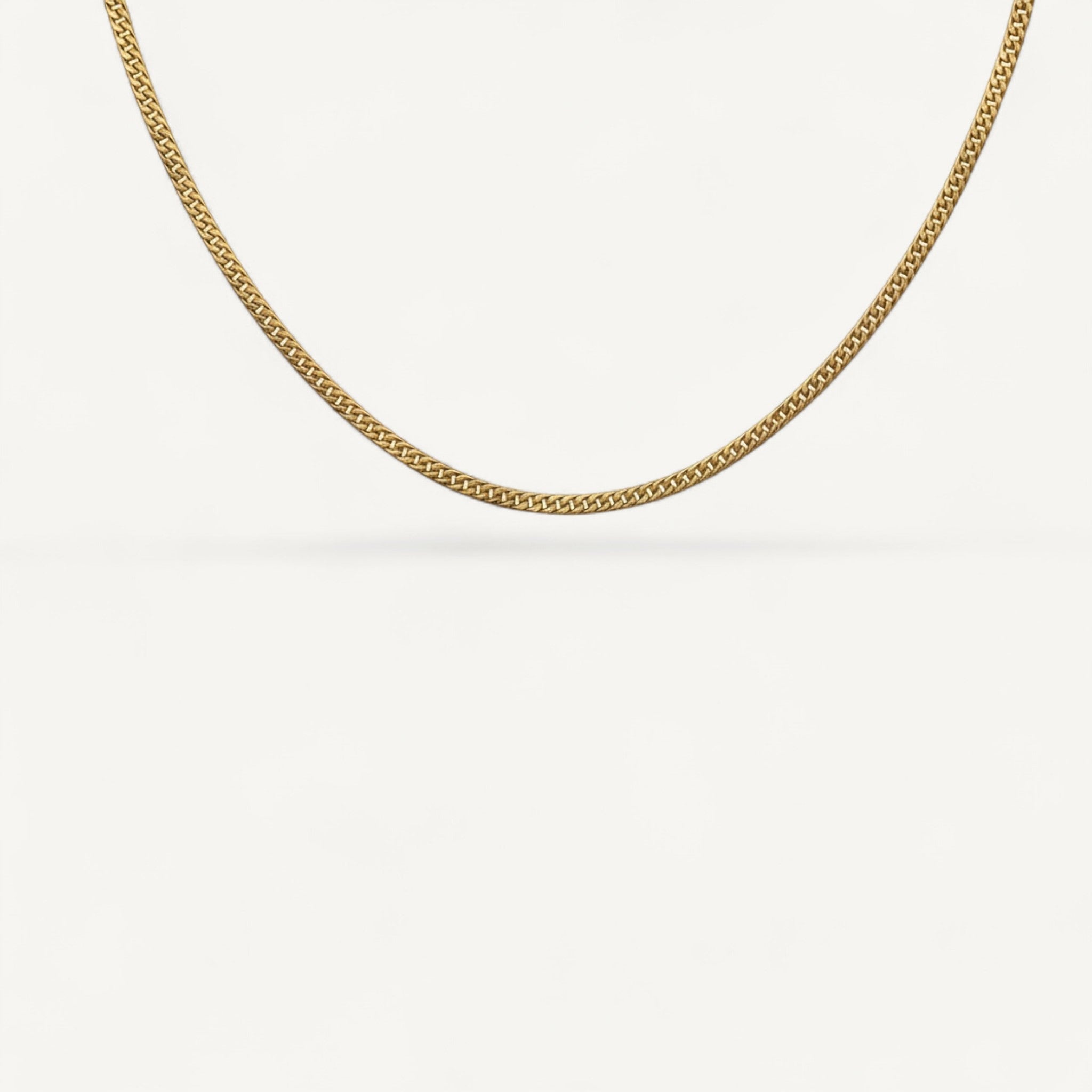
The published number is also what makes home verification possible. A pocket or kitchen scale that reads to 0.1 g costs about $15, and weighing a chain takes ten seconds. If the listing said 4.0 g and the scale says 4.0 g, the two facts agree and the seller's other claims earn credibility. If the scale reads far under the published figure — or there was never a figure to compare against — you have learned something no amount of product photography could tell you. We publish the approximate gram weight for every length on each chain's page: our 2.5 mm Ethos Subtle Cuban chain, for example, lists roughly 3.7 g at 18 inches through 4.9 g at 24 inches, so the ten-second test is available to anyone who buys one.
Check 3: The karat stamp — what 417 and 585 mean
The number stamped into a piece is its gold content in parts per thousand: 417 means 41.7 per cent pure gold, which is 10K, and 585 means 58.3 per cent, which is 14K. In Canada these quality marks fall under the Precious Metals Marking Act, and a marked maker is held by law to the mark's accuracy. A seller of solid gold should be able to point out the mark — or explain why the piece does not carry one (marking is voluntary in Canada; accuracy is what the law mandates). How to find and read the stamp — and what an absent stamp does and does not mean — is covered step by step in our guide to telling if gold is real. If you are choosing between the two karats themselves, 585-stamped pieces sit in our 14K gold collection.
Check 4: Spec completeness — serious listings put it in writing
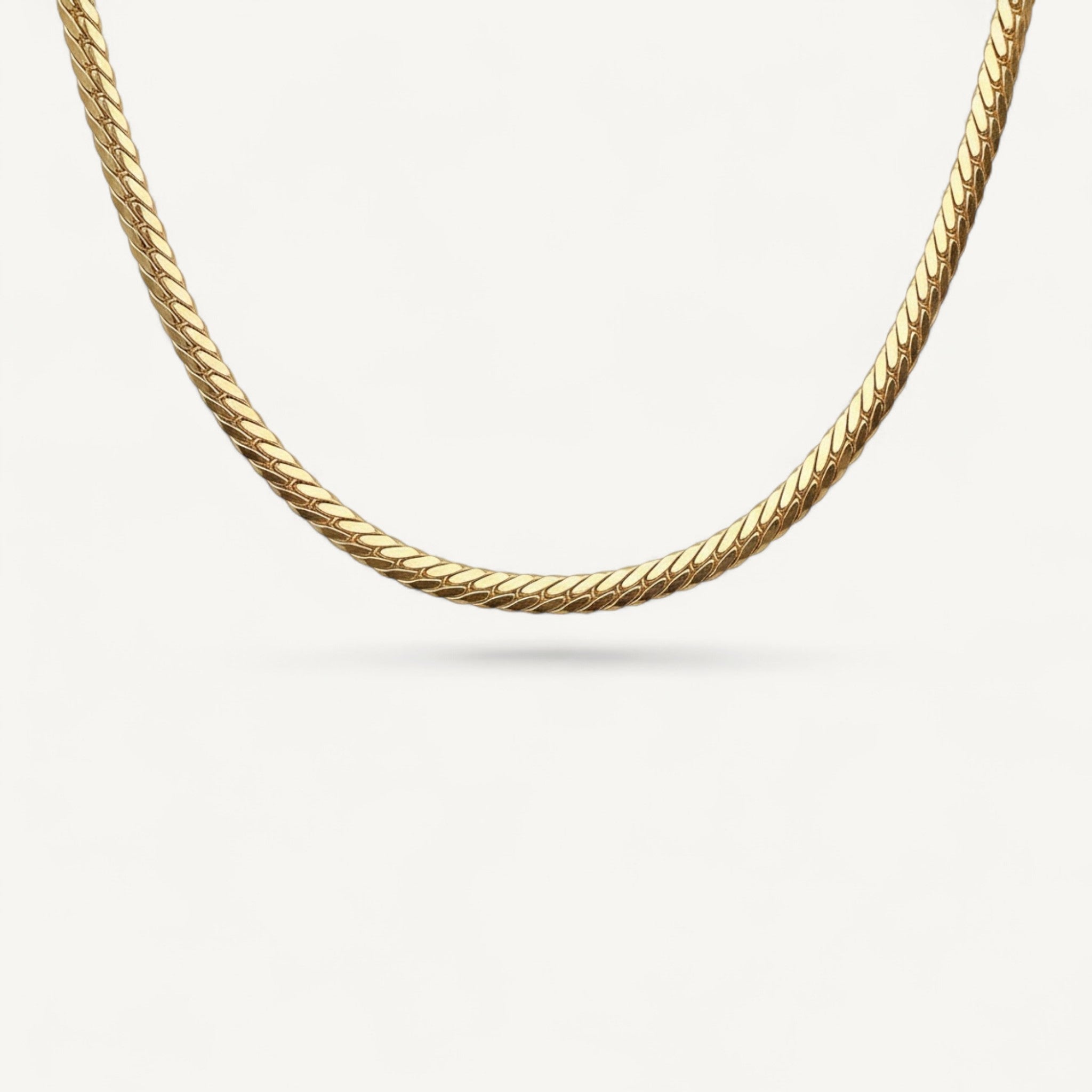
A listing that expects scrutiny reads like a specification sheet: karat, gram weight, width in millimetres, and country of origin, all in plain text. Take our 4.6 mm Veritas Enduring curb chain as a working example of the shape to look for — the page states solid 10K yellow gold, the width, the approximate weight at every length from about 12.3 g at 18 inches to 16 g at 24 inches, and that the chain is made in Italy. Whether you buy that chain or never visit the page again, that is the format a complete listing takes, and once you have seen it, incomplete ones become easy to spot.
The reason written specs matter is accountability. A number in the product description is a representation the seller can be held to under Canadian consumer law; a written number is far easier to hold a seller to than an impression. So when a listing offers "premium quality" where the karat should be and "substantial feel" where the grams should be, the silence is not an oversight — writing down four numbers is easy, and every seller knows their own product's weight. If a listing states none of the four, treat the silence as the answer to the question you were about to ask.
Check 5: Price sanity — the metal sets a floor
Gold has a live, public market price, which makes it nearly unique among the things you can buy online: you can sanity-check a price against the raw material in about a minute. A solid gold piece contains a known weight of gold at a known purity, and that metal has a spot value before any clasp, labour, or box is added. A finished piece must cost more than the gold inside it. So when a listing describes a piece as solid gold at a price visibly below the value of its own stated metal, the description and the price cannot both be true, and the price is the honest one.
You do not need to memorise figures, and we deliberately will not print per-gram numbers here (see current 10K gold chain prices in Canada) — the metal market moves, and a stale number is worse than none. The mechanism is what to keep: a "solid gold" piece priced below the value of its own stated metal is impossible — the maker paid for the metal and then did work to it. That is the only direction this check runs: a too-low price has already answered the material question. Our solid gold chains collection publishes weight per length on every piece precisely so this arithmetic stays available to you.
Check 6: After-purchase protection — the checks you re-run at home
The first five checks have a second life: the day the box arrives, you can run them on the physical object. Weigh the piece against the published grams. Find the stamp with a phone camera zoomed in. Compare the width against the stated millimetres. That is why the returns policy is part of the buying decision, not an afterthought — a returns window long enough to verify at home, from a seller who states one plainly, is the difference between a promise and a guarantee. Ours is 30 days from delivery, unworn and in original packaging, which is more than enough time to put a chain on a scale.
The full picture of what protects a Canadian buyer — card rights, policies in writing, duties, and what buying small actually trades — is in our guide to buying from a small Canadian jeweller.
Shop the checklist: four pieces that show what passing looks like
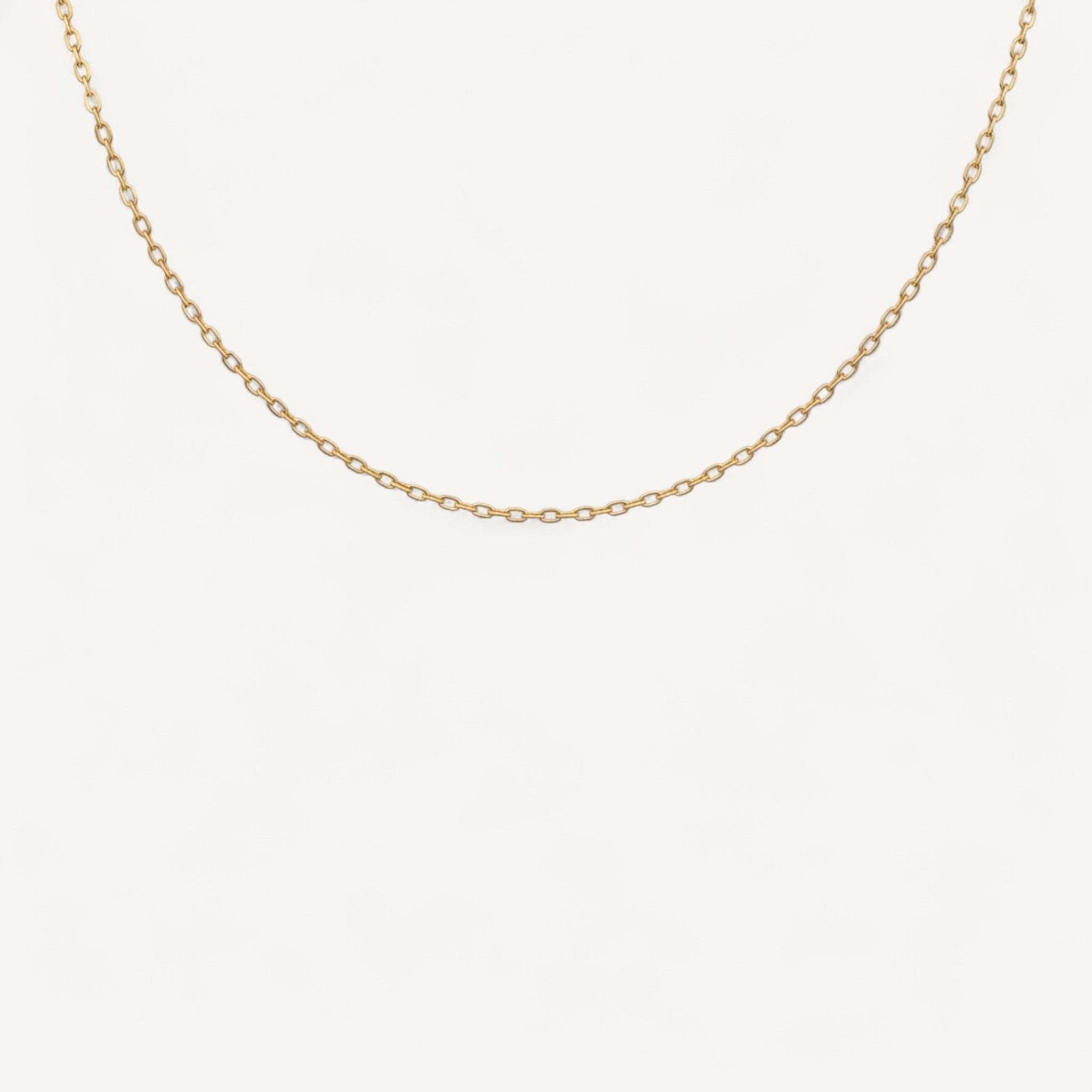
These four chains from our own catalogue are useful here less as recommendations than as worked examples — each page states the karat, the width, the gram weight per length, and the origin, so you can see the complete-listing format from check 4 in the wild and practise on it.
Shop the pieces in this guide: 10K Yellow Gold Vero Petite Oval Cable Chain Necklace · 10K Yellow Gold Ethos Subtle Cuban Chain Necklace · 10K Yellow Gold Veritas Enduring Curb Chain Necklace · 10K Yellow Gold Verve Substantial Box Chain Necklace.
How to choose: run the checks, then buy the piece you wanted anyway
The checklist narrows the field; it does not pick the piece. Once a listing passes all six checks, you are choosing between honest objects, and taste takes over. A few concrete recommendations by situation. If this is your first solid gold purchase, start small rather than not at all — a fine chain in the just under $250 to about $650 range is real gold that passes every check, and it teaches you what solid feels like on the skin before you spend more. If you are buying a gift, weight the specs and the returns window most heavily: the recipient should be able to run checks 2 and 3 themselves, and exchange freely if the length is wrong. If you are buying for a man, or buying a heavier piece, put your budget into grams before width — the men's jewellery collection runs from about 4 g to over 36 g, and the scale will always tell you which chain is the more substantial object, even when the photos will not.
And if a listing anywhere fails a check, the conclusion is not that the seller is a villain. It is simply that you cannot verify what you are buying, and gold — of all things — is a purchase you should be able to verify. A seller who publishes the numbers is inviting you to check them — it is the standard we built our own catalogue to pass, and the reason every check on this page can be run on any piece of ours the day it arrives.
Common questions about buying gold jewellery in Canada
How can I tell if gold jewellery is really solid gold?
Stack the checks rather than trusting any one of them. The listing should name the construction ("solid 10K gold", not just "gold"), publish a gram weight, and the piece should carry a karat stamp — 417 for 10K, 585 for 14K. When it arrives, weigh it against the published figure on a 0.1 g scale. A piece that passes all four is, for practical purposes, what it says it is.
How much should I spend on gold jewellery?
Spend enough to buy real metal, at whatever scale that means for you. A fine solid 10K chain starts around just under $250 CAD; substantial pieces run into the thousands because they contain many times the gold. The principle that serves buyers best: a small piece of solid gold outlasts a larger piece that is gold only at the surface, so decide your budget first, then buy the most honest object inside it.
What does the 417 or 585 stamp mean?
The stamp is gold content in parts per thousand. 417 means the alloy is 41.7 per cent pure gold — that is 10K. 585 means 58.3 per cent — 14K. On chains and bracelets the stamp usually sits on the clasp tag; on rings, inside the band. It confirms the karat of the metal it is stamped into, which is why it is read together with the listing's construction claim, not in place of it.
Is 10K gold worth buying, or should I wait for 14K?
Both are solid gold, and for pieces that take daily contact — chains especially — 10K's harder alloy is a practical advantage, not a compromise. 14K carries more gold per gram and a warmer colour, and costs accordingly. Our honest answer on whether 10K gold is good covers the durability and colour trade-offs in full.
Do I pay duties when buying gold jewellery online in Canada?
Only when the order crosses the border. A piece priced in CAD and shipped from within Canada arrives with taxes calculated at checkout and nothing collected at the door. An order from a seller shipping from abroad can attract duties, brokerage fees, and exchange-rate spread on top of the sticker price — check the shipping page for the origin before you pay, not after.
Shop this guide



Read more
If you have followed gold jewellery prices in Canada for any length of time, you have watched numbers do something jewellery is not supposed to do: change. The same solid gold chain can cost more t...
Gold chain width is the measurement that decides how a chain reads before anyone notices the link style, the length, or even the shine: whether it sits as a fine line of gold, a visible everyday ba...