


Buying guide · Tennis bracelets
Lab-grown tennis bracelets
What each size gives you, in solid 14K gold.
8 min read · 2026-11-16

A lab-grown diamond tennis bracelet puts a full line of real diamonds around the wrist for well under what the same carat total costs in natural stones. The harder question is what each step up in size actually buys: more carats, more gold, a different look on the wrist, and a higher price that does not rise in step with any of them. This guide answers it with our own numbers, from sixteen tennis bracelets in solid 14K white and yellow gold, in two setting lines and four sizes, all made at 7 inches.
New to the style? Start with what a tennis bracelet is; the general checklist for any tennis bracelet is in our tennis bracelet buying guide. This page stays on the size ladder, and what each rung gives you for the money.
What changes as the diamonds get bigger
In a tennis bracelet, the stone size in millimetres is the number that sets everything else. Carat weight follows the volume of a stone, not its width, so the carat total climbs much faster than the millimetres do. On our Heritage Prong line, moving from 2.0 mm stones to 3.0 mm stones makes each stone half again as wide, and the carat total doubles, from about 2.75 ct to about 5.5 ct. The price rises far less than that: the 3.0 mm bracelet is about $2,600 in lab-grown diamonds, against about $1,800 at 2.0 mm.
The gold rises too. Bigger stones need bigger settings, and the published gold weight goes from about 5.9 g at 2.0 mm to about 8.9 g at 3.2 mm. That figure is the 14K gold alone; the diamonds add to the finished weight. Here is the full Heritage Prong ladder in lab-grown diamonds, as the product pages list it.
| Size | Stone | Carat total | Gold weight | Lab-grown, from |
|---|---|---|---|---|
| Petite | 2.0 mm | 2.75 ct | about 5.9 g | about $1,800 |
| Petite | 2.3 mm | 3.75 ct | about 6.4 g | about $2,000 |
| Petite | 2.5 mm | 4.5 ct | about 7.4 g | about $2,300 |
| Classic | 2.7 mm | 5 ct | about 7.9 g | about $2,400 |
| Classic | 3.0 mm | 5.5 ct | about 8.4 g | about $2,600 |
| Classic | 3.2 mm | 6.75 ct | about 8.9 g | about $2,800 |
| Bold | 3.5 mm | 8.5 ct | about 9.3 g | about $3,100 |
| Statement | 3.8 mm | 9.25 ct | about 9 g | about $3,500 |
Statement continues in larger stone sizes, up to about 26 ct total; the current sizes and prices are on the product page. On the wrist, the steps read like this. At 2.0 to 2.5 mm the bracelet is a fine bright line that sits comfortably beside a watch. At 2.7 to 3.2 mm it reads clearly as a row of diamonds across a table. From 3.5 mm up, each stone is visible on its own from across a room. Product photos are styled and not to scale, so lay a ruler on your wrist and look at 2, 3 and 4 mm before you choose.
Heritage Prong or Crownline: the two settings
Both lines hold round diamonds in a continuous row of hinged links. The Heritage Prong line holds each stone in a four-prong setting, which leaves most of the stone open to light. The Crownline line uses a crown-inspired setting that our product pages describe as low-profile, so the row sits a little closer to the wrist. The general lesson on prong and other settings belongs to our tennis bracelet explainer; what matters here is how the two lines compare on paper.
The same stone size gives a different carat total in each line. At 2.0 mm, the Crownline Petite lists about 2.25 ct against 2.75 ct for the Heritage Prong Petite; at 3.5 mm, the Crownline Bold lists 6.5 ct against 8.5 ct. Crownline carries slightly more gold at the small sizes (about 6.6 g against 5.9 g at 2.0 mm), and at the larger sizes it starts lower in price, with the Bold at about $2,700 against about $3,100. So compare carat totals and stone size, not size names. Choose Heritage Prong for the most diamond at a given stone size; choose Crownline for a lower line on the wrist.
Lab-grown or natural, honestly
A lab-grown diamond is a diamond. To the eye, a lab-grown stone and a natural one of the same size and quality look the same on the wrist; what differs is where the stone came from and what it costs. Our Petite and Classic sizes are offered in either stone, chosen when you order and named in the variant you pick. At the same size, the natural version costs roughly two to more than three times the lab-grown one. Bold and Statement are made in lab-grown diamonds only.
If the origin of the stone matters to you, natural is there in the smaller sizes. If what you are buying is the look of a full diamond line, lab-grown puts more carats on the wrist for the same budget. The full comparison, including how each is made and how they are graded, is in our honest guide to lab-grown and natural diamonds. Three lab-grown options, one from each part of the ladder:
 Heritage Prong Petite
2.75 ct tw · 2.0 mm lab-grown diamonds
From $1,799.00 · Afterpay at checkout
 Heritage Prong Classic
5 ct tw · 2.7 mm lab-grown diamonds
From $2,399.00 · Afterpay at checkout
 Heritage Prong Bold
8.5 ct tw · 3.5 mm lab-grown diamonds
$3,099.00 · Afterpay at checkout
Fit and clasp: 7 inches, plainly
Every tennis bracelet we sell is made in one length: 7 inches, listed on each product page as a standard fit. A tennis bracelet is usually worn with a little room so it moves without sliding far down the hand. Measure yours snugly with a soft tape or a strip of paper and a ruler. If you are unsure, email us before you order and we will tell you plainly how it will sit.
Close it, then give the bracelet a gentle tug before you head out; a habit worth keeping with any tennis bracelet.
Check it at home
When the bracelet arrives, a ruler and a kitchen scale will tell you whether it matches the listing. In Canada, stamping precious metal is voluntary, but a stamp that is there must be accurate, and every piece we sell is stamped. For weight, remember that the gold weight on the page is the gold alone: one carat of diamond weighs 0.2 g, so a 3.0 mm Heritage Prong (about 8.4 g of gold and 5.5 ct of diamonds) should come out near 9.5 g. The full method for testing gold at home is in how to tell if gold is real.
Check it yourself
- Find the 14K stamp; zoom in with your phone camera.
- Lay a ruler across one stone: it should match the mm size you chose.
- Measure end to end with the clasp closed: 7 inches.
- Weigh it: the gold weight on the page plus 0.2 g per carat.
- You have 30 days to return it, unworn with tags, in its original packaging.
Ask a real person about size
If you are between two sizes, or between the two settings, tell us your wrist measurement and what the bracelet is for, and we will tell you which one we would choose and what it will look like at 7 inches. A real person answers. If it is a gift and you do not know the wrist size, say so and we will help you choose.
info@jewelrytoremember.com
Which lab-grown tennis bracelet to choose
For a first diamond bracelet worn most days, choose the Classic at 2.7 or 3.0 mm: about 5 to 5.5 ct of lab-grown diamonds, clearly a diamond line without becoming the whole outfit, from about $2,400. Choose the Petite, from about $1,800, if you will wear it beside a watch or stack it, or if you want the entry point. Choose Bold or Statement when the bracelet is the point. Pick white gold if you mostly wear silver tones, yellow if you mostly wear gold; the diamonds and sizes are the same in both. Afterpay is available at checkout if you would rather spread the cost, and our Solid-Gold Guarantee sets out the terms behind the metal.
Common questions
Is a lab-grown diamond tennis bracelet worth it?
A lab-grown diamond tennis bracelet is worth it if you want the look of a full diamond line, because the stones look the same as natural ones and cost far less per carat; the trade-off is origin, not appearance. Buy it to wear rather than to resell.
How many carats should a tennis bracelet be?
There is no right carat total for everyone; it depends on how visible you want the line to be. Ours run from about 2.25 ct at the smallest Crownline size to more than 9 ct in Statement, and 4.5 to 5.5 ct is the middle ground where the row reads clearly without becoming the focus.
What length is a tennis bracelet?
Our tennis bracelets are all 7 inches, a common standard length, and are not made in other lengths. If you are unsure of your wrist size, email us before ordering.
How can I tell my tennis bracelet is real 14K gold?
Start with the stamp: solid 14K gold is usually marked 14K or 585, and every piece we sell is stamped. Then weigh it against the gold weight on the product page plus 0.2 g per carat of diamonds; our guide on how to tell if gold is real has the full method.
Not ready yet
$25 off your first piece when you join our emails. Unsubscribe anytime.
Made to keep
Ships from Canada. Order early for the holidays.
Read next: Tennis bracelet buying guide · Lab-grown vs natural diamonds · What is a tennis bracelet?
Read more
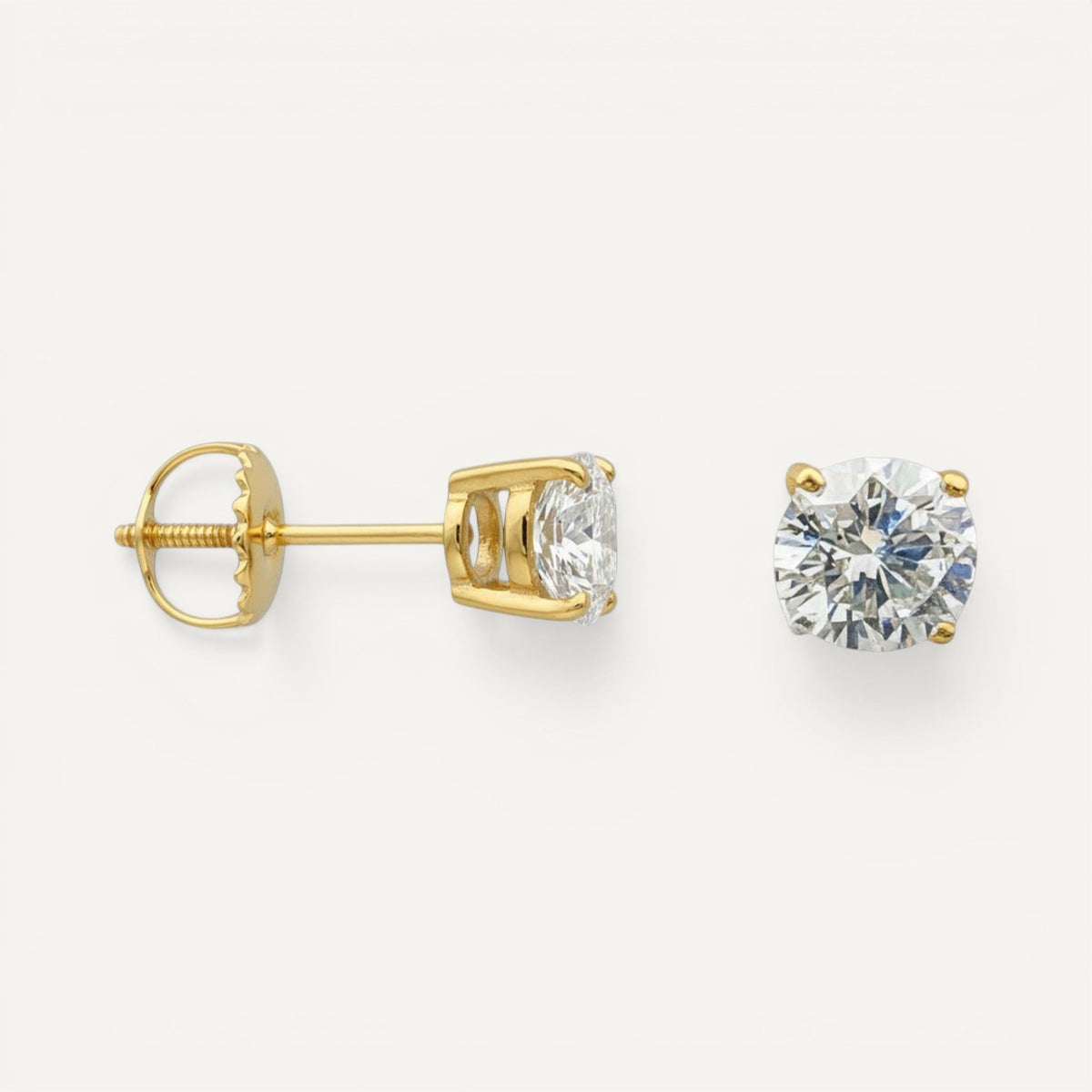
On a pair of studs, 1 carat usually means the total for both earrings, so about half a carat a stone. A carat-to-millimetre chart from our own sizes, lab-grown or natural at this size, yellow or wh...

What a herringbone chain is, why it can kink, which width suits you and how to keep it flat, with the widths and gram weights published on our two 10K herringbone chains.